



 Carry Awards
 Insights
 Liking
 Projects
 Interviews
 Carry Candy
 Community and Marketplace

Insights
Carryology X Trakke: Uniting Tech and Tradition
We asked you what your dream collab would be. And now, we’re extremely excited to announce our third collaboration project is with one of our all-time favorites – and one of the brands you asked for. Scotland’s inimitable adventure travel brand, Trakke.
To combine our knowledge and passion for great carry with Trakke – a Carry Award champion that has delivered timeless design and supreme quality, release after release – has been an opportunity to revel in. We started with some questions: How could we weave their mastery of craft with our hard-earned knowledge? What could we do to take it to the next level? How could we incorporate real innovation?
Read on to find out how we designed the answer.
Storr: Starting at 1st class
As a team, we’ve played with the world’s great travel bags, and have collected a dossier of the features that make a truly great ‘one bag’ travel bag, but we’ve never found one that had it all. So that’s what we wanted to create with this project.
We wanted to create something that blended rugged durability, versatility and good looks. That made excellent work of ‘usable space’. And that had everything a bag like this needs, with nothing it doesn’t. Of course, we were also sure it needed 10/10 X-factor.
So we dug into Trakke’s stable and locked on their Storr – loved by reviewers all over. It would be our foundation design onto which we could build something remarkable. And, with Trakke’s open invitation, I was on a plane from Austin, Texas to Scotland.
Sailing beyond borders
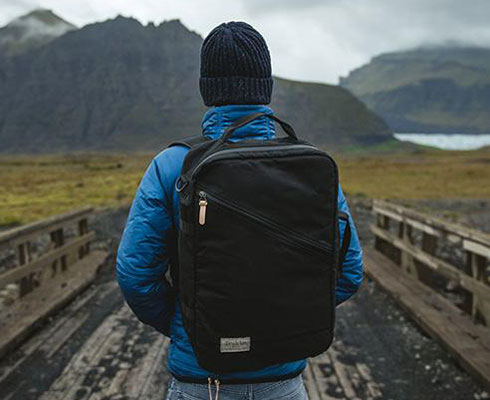
Trakke’s HQ is located in the hip corner of Glasgow. There’s a dozen brands, artists, startups, and organizations all located in the massive shared warehouse space where Trakke calls home. Through the winding hallways of the complex and up the elevator, I’ve arrived. Trakke’s workshop is a warm antidote to the brisk Scottish weather outside, in more ways than one. Upon meeting Alec (founder, owner), Madeleine (designer, studio manager), Alexander (head of marketing), and Rowan (head of production) I’m incredibly pleased with the team I’m here to work with. I’ve said this before in my life, but this time I really mean it… we were immediately close friends.
Alec gives me a tour of their headquarters and workshop. Craftsfolk sew away at beautiful waxed cotton packs and messengers, rolls of the world’s finest cotton stack head-high from wall to wall.

We share jokes, laugh, and probably man hug one too many times. But I’m here for “work” and we’ve got to keep the progress of the collab rolling. Into the design room. Out come the sketchbooks, material swatches, and some very rough prototypes they’ve already worked on. It’s on.
Days fold into days, and the final form starts coming together. A serious one-bag solution, that still uses Trakke’s design language and roots, with Carryology’s special spin on it.
We reach into the archives of some previous Trakke designs that couldn’t be done before, some ideas they had already been working on, and some secret features and construction methods that I have been squirreling away for some time.
We agree to take advantage of this opportunity, to push Trakke beyond its usual borders of ‘tradition’. And to introduce something that’s dear to our Carryology family – cutting-edge tech. This would be something daring and special, that without our teaming up, Trakke would probably never have the license to try. Party!
Taking flight with the lightest fabric in the world
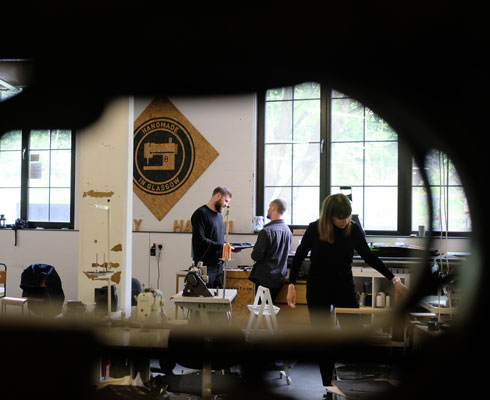
We jam on the makeup of a perfect travel pack, the need for that ‘ruggedness’ that can help a pack move from urban worlds to the outdoors, to ride those bumps and scuffs and whips of heavy weather. But every pack we’d carried that nailed ‘rugged’ had come with a weight penalty… lightbulb… we’d use the world’s strongest and lightest fabric on the planet. A fabric which first came to infamy in the sails of racing yachts. Dyneema! But not just the black or raw colorway we’ve all seen – we agree we need to go bigger, better. So we reach out to the Dyneema Project – an elite program for premium brands – to gain access to their newest experiments. And we find just what we’re looking for: CT5K.18/wov.32c. In normal speak: mind-bending translucent orange.
Not only would it trim weight, add strength and weatherproofing, clean easily, and increase visibility when rummaging for essentials, but it’d totally fit with our now signature collab internals – orange pop lining.
That’s right, the lining and lining only. You see, going all Dyneema would have been too much. It wouldn’t have been, well… ‘Trakke’. Everything else will be sourced from the UK. Canvas and steel and loveliness.
Learning from the Swiss – and soaring higher
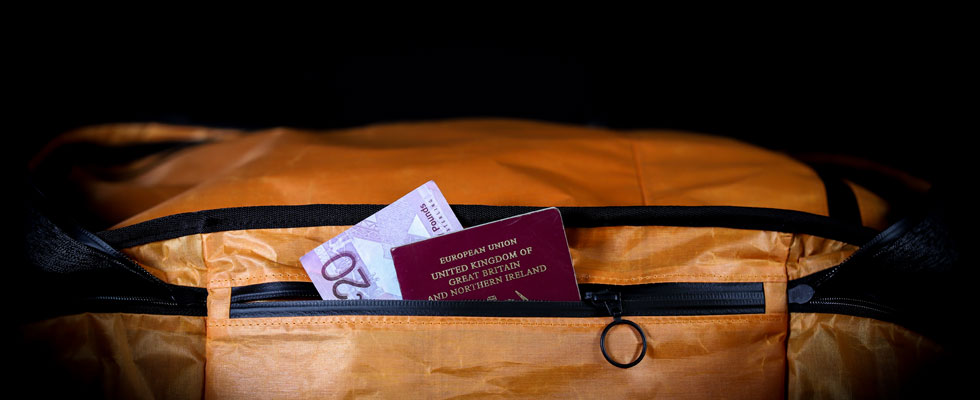
If you’re familiar with Trakke’s offerings, which have long been Carryology favorites, you know they’re fans of waxed cotton. Not only is waxed cotton a main ingredient in their products; you could say it’s in their DNA. Waxed cotton’s history dates back to the 18th Century sailors from England and Scotland who used it to make clothing and sailcloth. That’s right: sailcloth.
So this one bag travel pack will be the representation of 200 years of sailing innovation combined. Dyneema meets waxed cotton. Past meets present. Or maybe even the future?
We don’t want to just pick out a color off a roll and call it a day. Nope. Alec and I hop in his van and take a few hour road trip up to Dundee, the home of Halley Stevenson. Halley Stevenson makes arguably the best waxed cotton on planet Earth. And they’ve been making it right here within the walls of their Dundee factory since 1864. Alec and the team here have a close working relationship and they’re constantly experimenting with different fabrics, coatings, patterns, colors and more. When we explain the project to their team of mad scientists, their eyes light up.
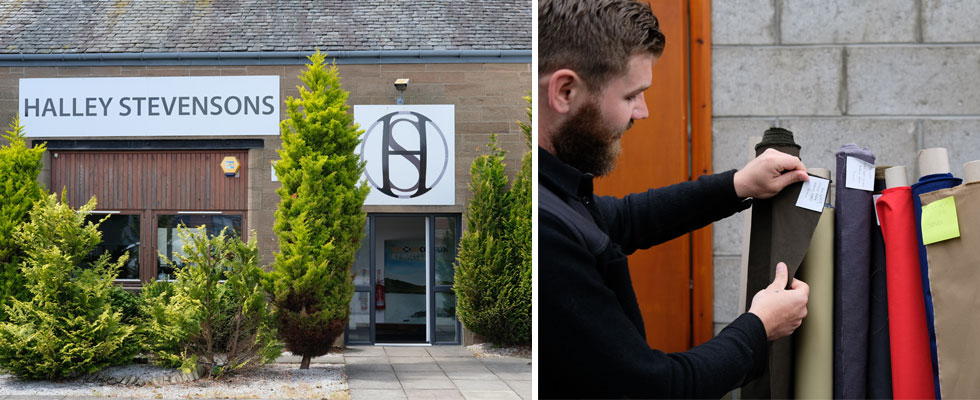
They pull out a fabric I’m familiar with (after handling the Bannoch), and this stuff deserves its own article. The base fabric is made from cotton mixed with stinging nettles. Stinging nettles! This idea actually came from the Swiss during World War 2. Switzerland, being such a small country with a neutral position in the war, had to maximize what little resources they had available within their borders. And cotton was nearly worth its weight in gold during this time. But they discovered that they could use stinging nettles in a cotton blend, which adds strength as well as a unique ‘salt and pepper’ coloring.
Of course, Halley Stevensons applies wax to this base fabric after it’s combined together, giving the salt and pepper a darker grey appearance. But, again, we’d need to go bigger. Find a way to weave in a modern twist – the ‘tech’. As the suggestion escapes my mouth, one of the Halley Stevensons’s representatives stands and runs out of the room. And a few moments later she returns holding an experimental fabric that was even darker. A special combination of a traditional waxed coating and a modern secret synthetic durable water resistant coating they've developed. We need no more exploration. Alec and I carry the roll, which contains barely enough yardage of this magical fabric, out to the van and run it back to HQ for prototyping.
Taking the details to another altitude
Over the next few days we adjust the pattern, bringing it to a healthy 35 liters. We add in a much-needed exterior water bottle pocket (that can also be used for accessory storage). We tweak the shoulder straps with a version of a WWII-style felt padded backpack strap (another nod to wartime ingenuity) but with super premium high-density felt. Stowable for when you need to check it in, of course.
A dual diagonal zipper on the front panel adds more versatility and gives the pack an aggressively awesome two-zip smile (high-fives all round). We then reconfigure the internal pocketing so you can gain access to them without opening the full clamshell. WIN.
My favorite addition? The bright orange Dyneema packing cubes. I’m a huge fan advocate of packing cubes while traveling. And these can’t be purchased anywhere else. Rare like hen’s teeth.

Some other fun bits worth noting: We initially planned to experiment using custom titanium hardware, but that would have increased the cost by a few hundred dollars per bag. So, we land on tried and true, real metal hardware, stainless steel. This is ‘buy it for life’ stuff.
Of course, we opt for YKK AquaGuard zippers, as they slide nice and smooth and are extremely water resistant, just like the rest of the bag.
We design three exterior grab handles so you can carry it however you prefer (top, bottom, side), which helps when maneuvering the pack in or out of overhead bins. And finally, the luxurious hipbelt and sternum strap are designed to be removable, so folks can choose to trim down or add-on when a fully-loaded pack calls.

Prototype done – set for takeoff
After several prototypes, dialing in all the details, the Storr SP (Special Projects) is born. Our ideal one-bag travel system using the original Storr as the foundation. A pack made with only the finest materials, classic and cutting-edge, combining the beauty of traditional craft with the smarts of modern technology. All while being handmade in Scotland at Trakke’s headquarters.
We all stand around it super proud. It’s everything we wanted to achieve.
Next step: testing. In the morning, we pile into Alec’s van and head to the Highlands. It’s beautiful and rugged and wild – and the perfect testing ground. Rains fall and the winds bite. We jump across streams, traverse up mountains and through gullies, and the pack performs like planned. It’s gorgeous. It’s a wrap.
After I return home, Alec’s team continues to tinker and finesse and make it ready for its final reveal to the world. A reveal only days away. And boy are we excited to unveil it to you!

Launch date
This Thursday, 25th of Oct (8pm EDT New York time)!
And you guys, our readers, will have exclusive first dibs, nearly three full days before the public. Please note, this pack will be an ultra-limited edition – only 100 handmade pieces available – so make sure you’re one of the lucky ones!
Mark your calendars. Get ready for the big reveal. And keep an eye on your inbox or our blog for the exclusive shop link.
Global times
NY – Oct 25th, 8pm
LA – Oct 25th, 5pm
London – Oct 26th, 1am
Vancouver – Oct 25th, 5pm
Sydney – Oct 26th, 11am
Singapore – Oct 26th, 8am
Berlin – Oct 26th, 2am
Paris – Oct 26th, 2am
Tokyo – Oct 26th, 9am
 WAYS TO CARRY
Nettle has been used in Europe for hundreds of years – it’s essentially indistinguishable from linen, and produced in the same way. Once it’s processed, it doesn’t sting.
I’m a spinner and weaver, and interested in the history of fibres and weaving.
“only 100 handmade pieces available” – I vote that we stop using the term handmade when describing bags or any other sewn good for that matter. All sewn goods are “handmade” but it only every gets called “handmade” when a white person makes it or is made in a English speaking country. If you want to highlight the fact that the bag is made in Scotland thats great, please do, or talk about how the shop works or the people in it. But just calling it “handmade” implies that people making bags in Asia are not devoting the same effort or amount of physical labor to making the bags and is really reductive.
Good point! However, Asian production *usually* involves long production lines with sewing operators repetatively undertaking a single operation – they’re single cogs in a machine. At Trakke and at other cottage manufacturers there are too few machines & too small a workforce for that approach. Your Trakke bag will be the product of maybe one to three different people’s *hands-on* input.
In a CSR report I saw a big brand claiming that their average bag goes through 22 different sewing stations. So your bag will be the product of about 30 pairs of hands – factoring in these separate non-sewing operators; spreader, cutter, heat press/embroidery, trim press operations (e.g. eyelets), etc. For starters, most small manufacturers like Trakke don’t even have 22 sewing machines!
Also wage ratio between sewing operators & management is small (e.g. 2:3) compared to say a Vietnamese factory with Korean bosses (perhaps 1:100!?)
There isn’t a common vocabulary used to distinguish the differences here. Perhaps you can make a suggestion?
Thanks for the reply! This is the kind of information I think should be highlighted when writing about what makes the manufacturing of a bag like this unique. Does Trakke do their own manufacturing or is an independent local factory? How many sewers do they employ? How long does it take to make this bag? Are there challenges for a company that mostly works with organic materials to switch over to DCF? I know this might feel a little nitty gritty but this is a bag blog and the writers and readers clearly care about all kinds of details about these products, lets keep learning.
I often hear “small batch manufacturing” used to capture some of this conceptual difference in manufacturing style but I’m not sure if that feels completely correct because I know some of these operations can turn out large numbers of product. Maybe this can be discussed in a @TeamCarryology:disqus article.
I like this website, no place really devotes itself so specifically to carry and has the same level of access to brands. So I get disappointed when they decide to hand wave important details or fall back on cliche.
I heartily agree. Arguably in-house production is the most important point of difference between small producers like Trakke and big brands who all predominantly outsource manufacture (with a tiny number of exceptions – e.g. Ortlieb.) This distinction also separates the likes of Trakke from the majority of small start-ups, who’ll launch on an investment of 500 piece production runs in Asia (e.g. most Kickstarter campaigns) rather than organically grow from a basic sewing operation and humble initial products.
The combination of outsourcing and selling wholesale have lead to brands focusing on consumer niches, while diversifying product-lines. Imagine being in a private meeting with your retailer, they suggest you take a rival’s product in a – new to you – product category, and put your own spin on it. What’s to stop you? All you need do is approach a factory with a sample of the rival’s product and request some minor changes and there you go…
Conversely, if you manufacture bags in-house then it’s easier to stick to making bags (with your specialist bag-making skills and specialist sewing machinery) and diversify by making bags for – new to you – consumer markets/niches.
IMO these two different imperatives combined with the big difference between on-shore and off-shore labour costs, explain the substantive differences across the carry market between brands’ different designs and their spread of product-lines.
Contrary to the general drift of my last reply, the ethical differences between Asian factories and cottage manufacturers might be less stark than most people imagine: Most Asian factory conditions have improved markedly in the last decade. So I wouldn’t assume ethical superiority for smaller Western manufacturers than the big Asian factories.
This is great insight! Thanks for your thoughtful responses.
Backpacks and technical textiles are my passion, so I’m more than happy to give my input. Thank you for your own thought-provoking contribution here – your initial point needed to be made and I hope @TeamCarryology:disqus will get into the habit of distinguishing designer-makers and production outsourcers – they’re very different entities.
Just chiming in to say: great points on both sides, guys. @TeamCarryology, please take a cue and drop more knowledge, fewer Kickstarter features.
Thanks Hogan – I agree.
In some ways, I think Carryology embodies the typical Kickstarter project – enthusiasts commendably having a go. They’ve lots of spirit – good on them. Yes, they’re a relatively new outfit and it’ll take time before they achieve a deep understanding of the design, technology, market & (getting into really the really profound stuff…) the economics of production. I hope – with our encouragement – they’ll grow into that.
Loving this conversation! Duly noted.
Totally valid points, and a completely valid enquiry, Philip! We use “Handmade” to reinforce the individual relationship that our makers have with the bags; it’s not something we’ve got space to elaborate on with such a small label, so use it as a shortcut, and try to push the full narrative on our social channels.
Happy to answer some of the questions though:
-We have 5 people on the machines. Rowan, Cory, Matt, Giedra, and Katy. You can see pictures of all of them on our instagram, and our other social.
-We do everything in-house, and we all work together as a team in the same space. Three in the office, five on the machines.
-We own our manufacturing, and have never outsourced for our bags. We’re trying to create an opportunity for talented UK based craftspeople to do the work they love, in a climate where those positions are being outsourced.
Not saying any of this to be preachy; it’s just what we can’t fit on the label. Kudos for asking such reasoned quesitons, and considering the ambiguity in these terms. It speaks really well of you as a consumer that you’re critical of what you see, as it’s no doubt to help you make better decisions.
Thanks for chiming in and answering some questions! Sound like you’ve got a great team and from what I can tell they do excellent work. The desire and ability to maintain in house manufacturing is a commendable one and I think that comes through in your unique design language. I can see from your instagram that you really are trying to tell a story about what it means to you to make these bags.
I understand the vocabulary limitations and am not trying to criticize you for putting “Handmade” on the label. I’m sure for 99% of consumers it either gets the idea above across, or just doesn’t matter to them. But there is 1% of us who not only care where the products come from but what that means to the people who make them. And I think there is probably a good amount of those people on this blog. So thats what my original comment was about, Carryology has the ability to dig deeper beyond the materials and pockets of a bag, they have done it in the past. I thought this article was a missed opportunity to do that, since they were working so closely with your brand.
What’s the price on these great sounding bags…or is that part of the big reveal?
That’s correct, @disqus_8KylNFslKf:disqus. You’ll have to the big reveal. Not long now!
Thank you for the link dudes! Scripting out the video for this bad boy this morning 🤤🤤🤤
YES!
Guys is it going to be black as on one photo or speckled as on the other?
Guys is it going to be black as on one photo or speckled as on the other?
Why was the comments section on the actual release disabled? There was some constructive criticism of the design choices, but nothing out of line. Disabling a comment section when trying to push the “100 limited edition items” is quite disingenuous to be honest
agree
Hey @yazbelinskiy:disqus, the thread grew and devolved into something quite the opposite from ‘constructive’. So much so, we decided to remove it. It’s a shame because there was some good discussion.
Just checked the product page– not sure I understand the water bottle pocket. Breaks the silhouette in a specific (and unbalanced) way that takes away some of the functionality. If you stow the backpack straps, the bag carries most naturally in ‘suitcase mode,’ but you’ve then got a non-collapsible pocket on the new bottom, keeping you from comfortably setting it down. So either you’ve got a bottle in the pocket and the won’t stand, or there’s a bunch of extra fabric because the pocket has dedicated volume and is not collapsible (and you’ve got a wasted pocket).
And, seriously, £450.00?