



 Carry Awards
 Insights
 Liking
 Projects
 Interviews
 Carry Candy
 Community and Marketplace

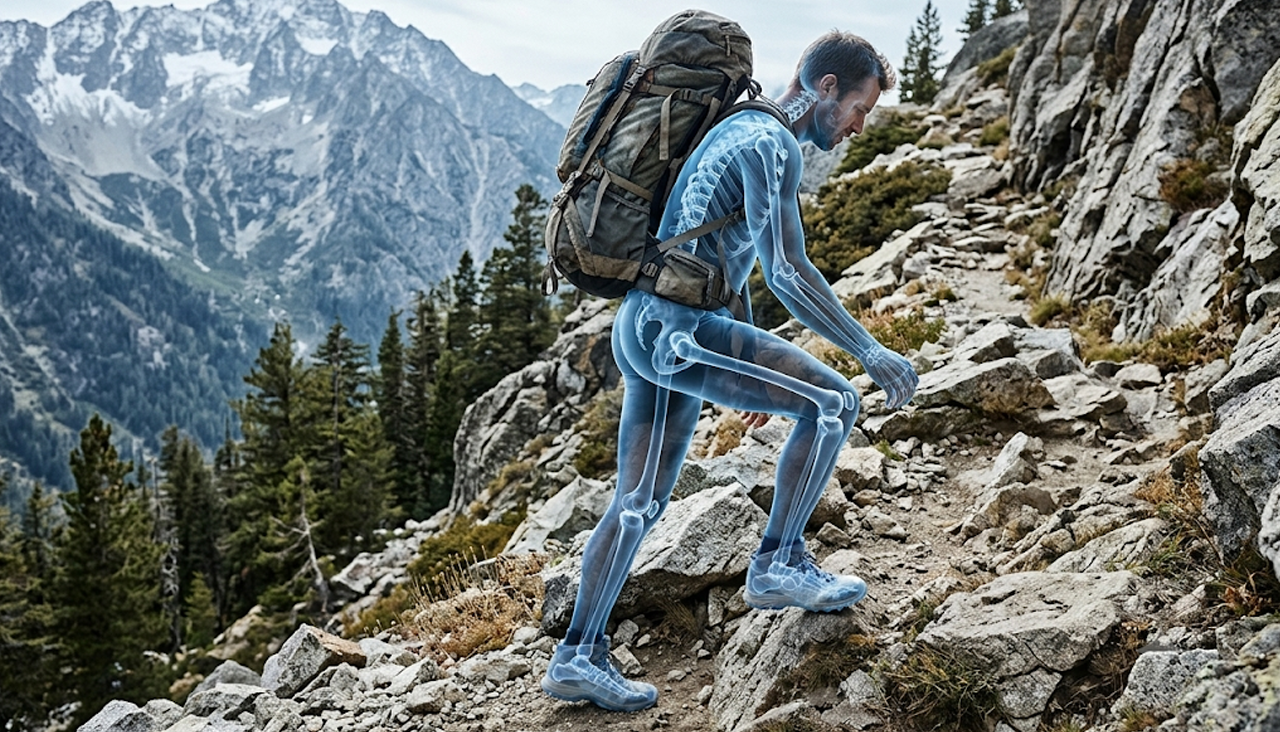
Load up your backpack and wander somewhere for an hour. You’ll notice your shoulders feel it first. Then your hips. Then your trunk leans forward and your stride shifts as your muscles begin, under strain, to negotiate with gravity.
Yet for all the complaints, our human body is remarkably good at doing this very thing. Carrying.
We may not be the biggest, strongest, or fastest animals on Earth – but give us a load, a pair of functioning feet, and a little time, and we’ll lug it a surprisingly long way.
In The Lost Art of Carrying Loads, we looked at the ancient carrying systems that different cultures developed long before modern packs, frames and load-bearing hardware.
This piece looks inside the machine itself: our skeleton, gait, muscles, metabolism, evolution, locomotion and load, and how we’re actually really well designed to carry.
But why are we humans so good at moving while carrying things? Or, perhaps an even more interesting evolutionary question: were we actually built to carry?
Well, let’s investigate.
‘We’re Walkin’ Here’
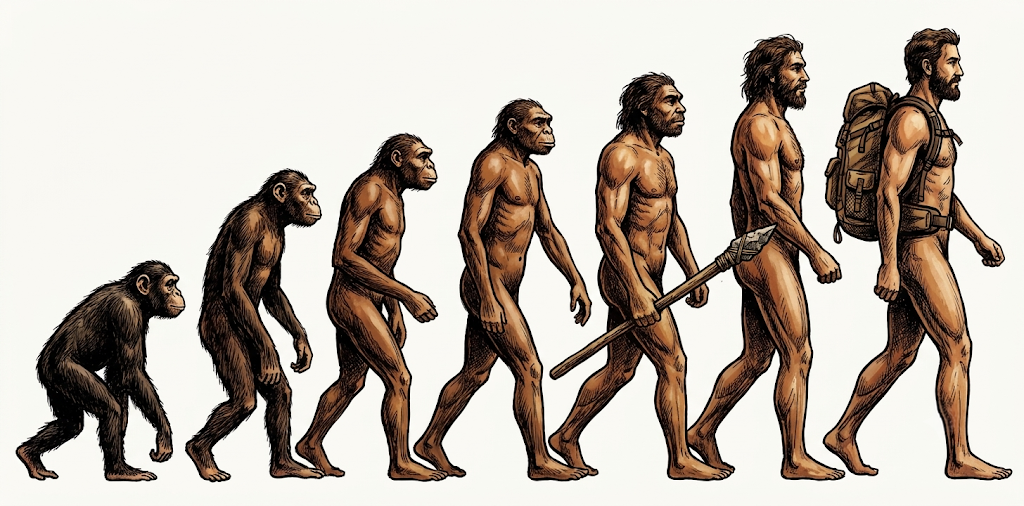
Through the forces of evolution, we humans became unusually committed bipeds. That means we walk upright on two legs, and we do it all the time, leaving our hands free to carry things.
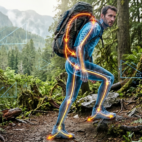
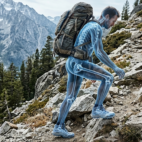
Bipedalism describes how our bodies have been organised around efficient upright locomotion: long legs, relatively short arms, feet with arches, aligned lower limbs, the shape of our pelvis, spinal curves and elastic tendons.
The human foot is a remarkable feat, because it’s a spring. The Achilles tendon and other elastic structures recycle energy, while the pelvis and trunk stabilise the body as each leg swings forward.
Walking for us is mechanically economical because we’re essentially allowing gravity, momentum and elastic tissues to do part of the work.
This sort of locomotion also frees up the hands, which is where carrying enters the scene. Once you’re striding upright, the hands can get busy with other tasks.
Now, walking is already an extraordinarily economical form of locomotion, but carrying extra mass increases the metabolic cost of moving from one place to another. Every step means accelerating and decelerating more mass, while your muscles work to stabilise the trunk and keep the load under control.
Distance, duration, terrain: it all matters. So does how the load interacts with your own movement.
This may be one of the more interesting things about human carrying ability: we aren’t particularly impressive when it comes to brute strength or speed. Plenty of animals can carry heavier loads relative to their body size. We’re not the fastest, we don’t have claws, fangs, or the kind of horsepower that makes other mammals look like they were designed by an arms manufacturer.
Where we start showing our stripes is in endurance: we’re particularly good at continuing to move once we’ve begun.
Good For The Long Haul
Why? Well, one of our big advantages is thermoregulation.
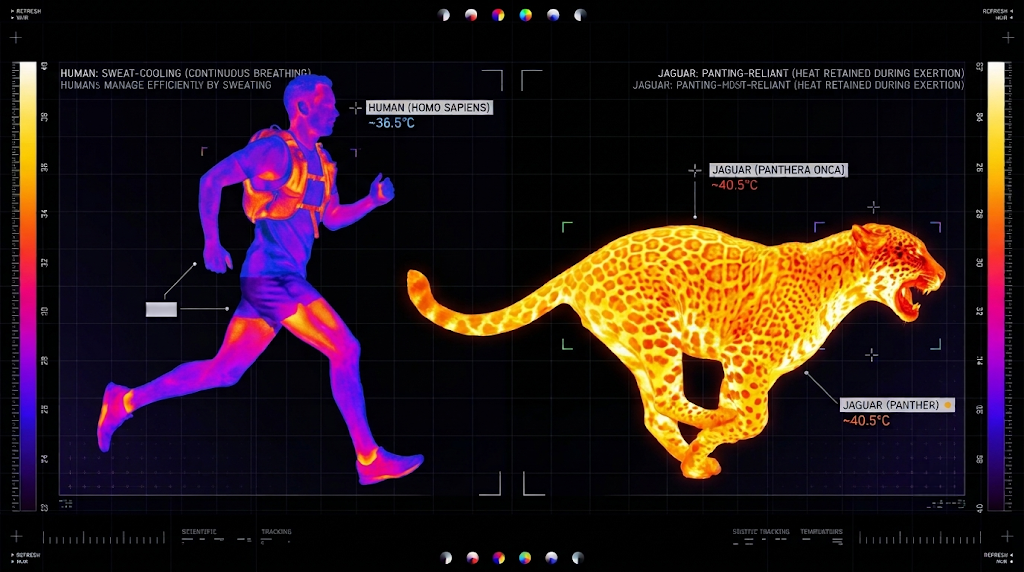
We’re unusually good at getting rid of heat. We can produce sweat across large areas of our relatively hairless skin, allowing heat to leave the body as that sweat evaporates.
Many mammals rely heavily on panting to manage heat, which becomes awkward when you’re trying to breathe efficiently while running. Humans can continue breathing normally while sweating heavily, allowing the respiratory system to focus on supplying oxygen rather than doubling as a roving air conditioner.
We’re also economical. Our long legs, elastic tendons, spring-like feet and relatively stable trunk don’t just make walking possible, they make it energetically cheap.
Put it all together and you get a special blend: a kooky primate capable of moving efficiently over long distances while carrying useful things along the way.
Food. Water. Tools. Firewood. Offspring. And, later in the piece, 70-litre backpacks full of camping goods.
Still, there’s a far more complex evolutionary story here than simply ‘humans evolved to carry things’. Carrying probably wasn’t the driving force behind bipedalism – there’s no neat moment in prehistory when somebody stood up and thought, “Ahh, fab … I can now lug miscellaneous goods from here to there.”
Nonetheless, once upright walking was established, the advantages were considerable: free hands, an efficient body that could move over distance, heat that could be shed while in motion, and the ability to incorporate a useful load into the locomotor system.
Beasts of Burden
To carry something can be useful. To be able to carry it to a specific destination, even more so.
For an animal that moves through a landscape on two feet, the ability to transport resources changes the possibilities of that landscape.
Food doesn’t have to be eaten where you found it. Water doesn’t have to be guzzled at the source. Tools can travel with you. Fuel can be gathered and brought back. And as a human parent, your offspring may just be the most important thing you ever cart around.
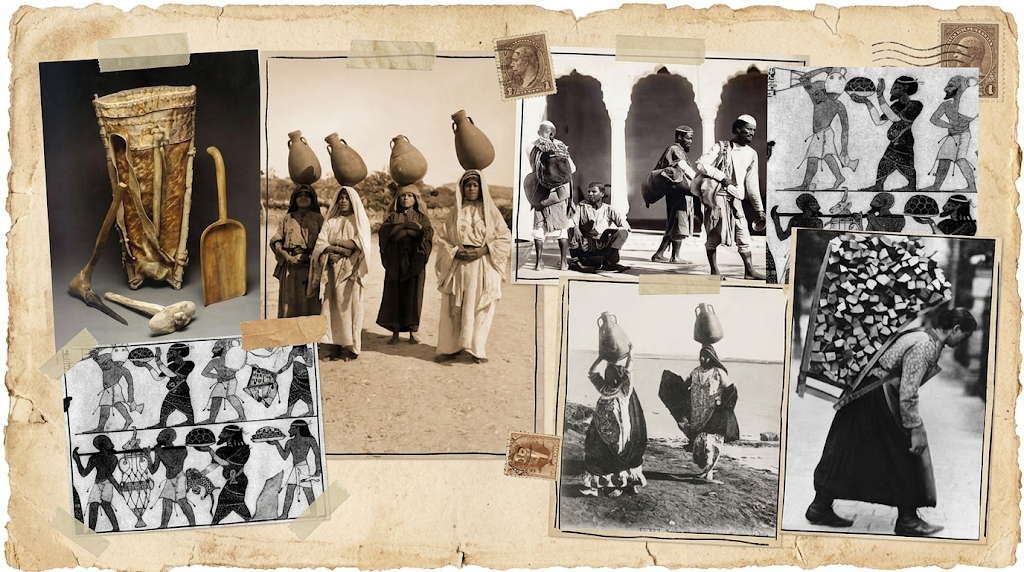
At some point, carrying became a logistical superpower. It sounds obvious to us now, but it’s a profound capability. That successful hunt could feed people who weren’t there. Firewood could be collected before the temperature dropped. Water and food could be transported from a riverbank to a camp, and stored for additional meals.
With our free hands, we’re especially well suited to this sort of mobile provisioning. We can walk efficiently for long periods, cool our jets with sweat, and incorporate additional loads into the same locomotor system.
A suite of adaptations for upright locomotion created a body in which carrying became extraordinarily useful. And once you’ve got the machine, you can start putting things in it, which we got very good at doing.




 WAYS TO CARRY