



 Carry Awards
 Insights
 Liking
 Projects
 Interviews
 Carry Candy
 Community and Marketplace
Insights
ICONS
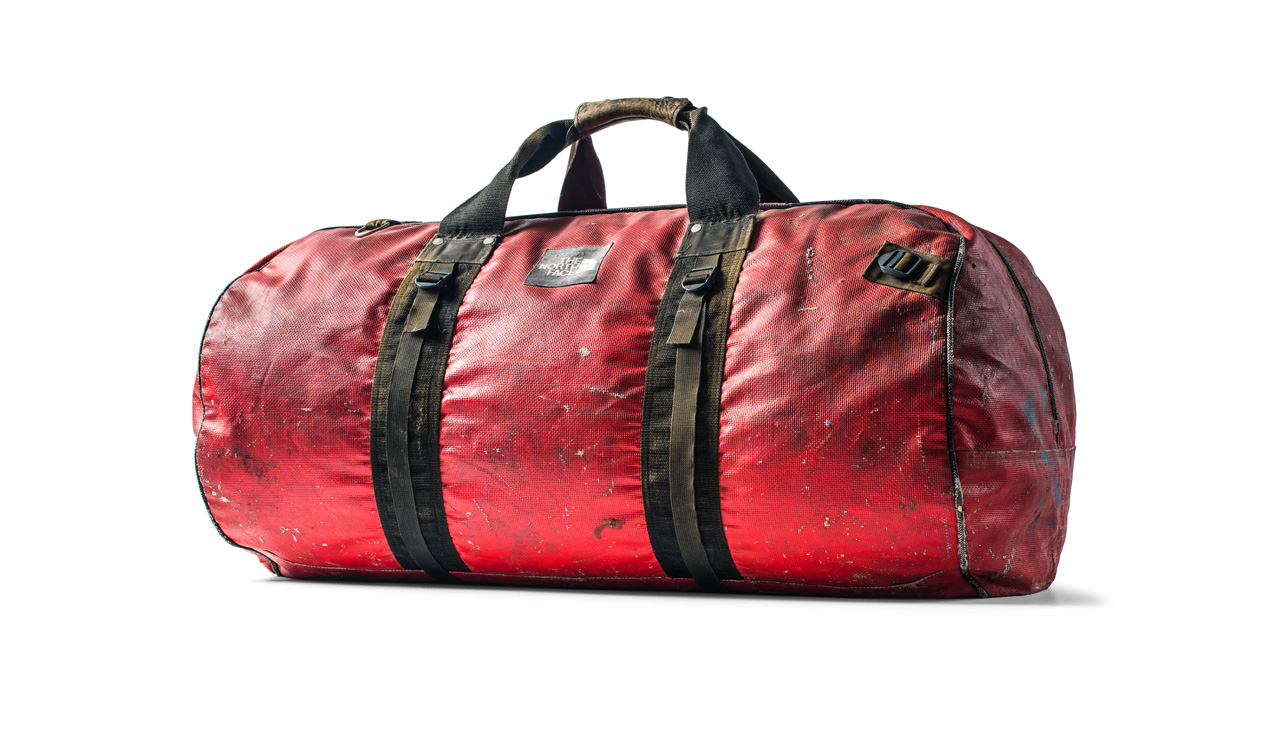
How The North Face Base Camp Duffel Became an Icon
There is a particular kind of object that achieves iconic status not by trying to be remarkable, but by being so completely, unimprovably itself that the world eventually catches up to it.
The North Face Base Camp Duffel is one of those objects.
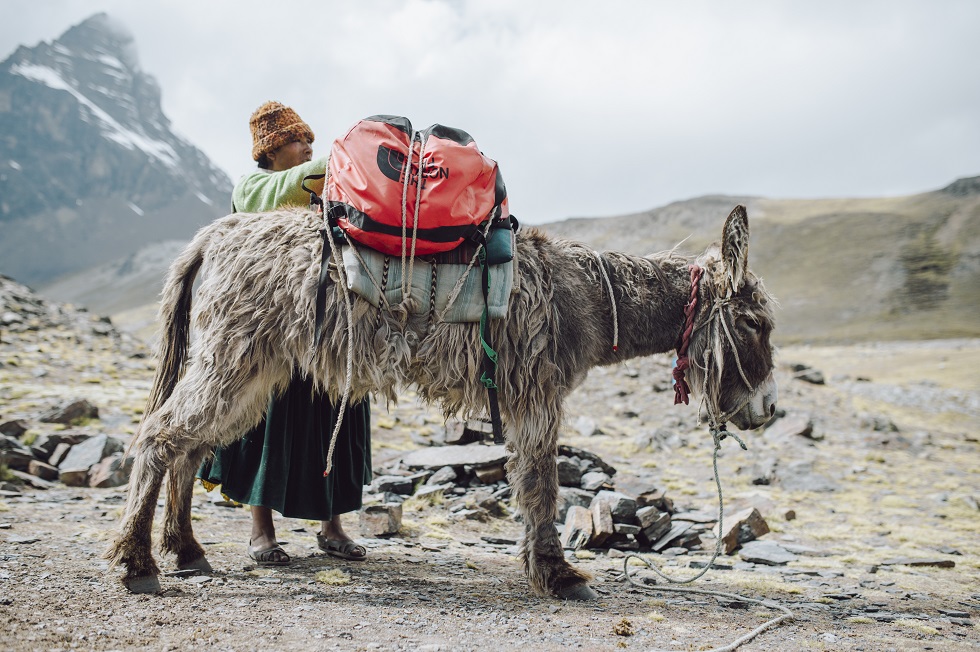
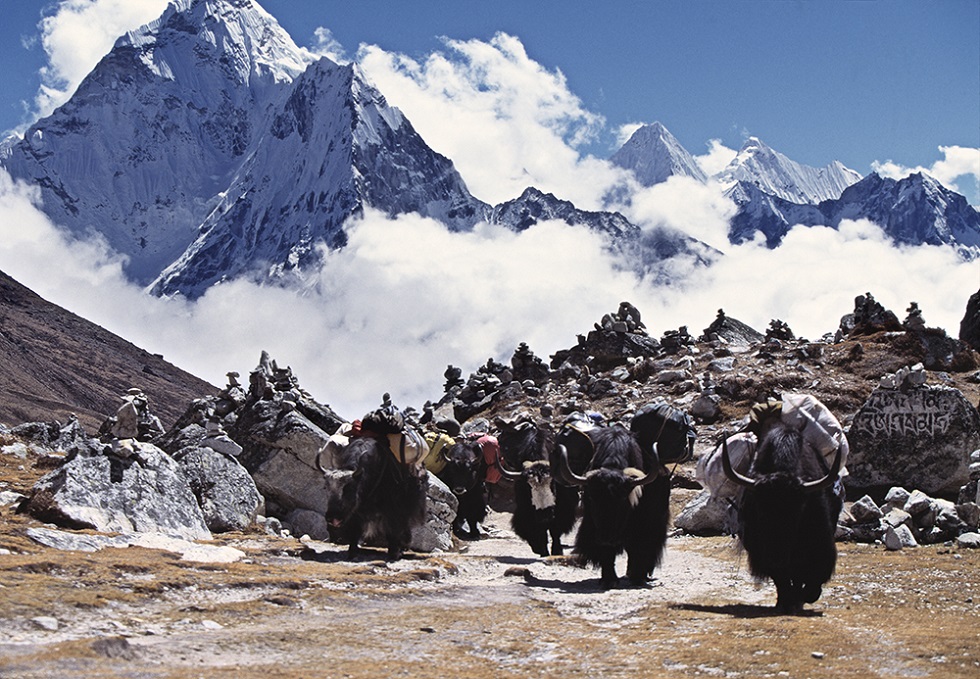
It has been dragged behind yaks in Nepal, lashed to the roof of jeeps in Patagonia, hauled onto float planes in Alaska, and heaved into the overhead bins of budget airlines by people who have never been within a thousand miles of a base camp in their lives. It has appeared in Supreme lookbooks and on the shoulders of Junya Watanabe runway models. It has been traded for yak rope at altitude. It has been carried by Conrad Anker on every expedition he has ever undertaken for The North Face — which is to say, on some of the most consequential climbs of the last four decades.
This year, the Base Camp Duffel turns forty. And the most interesting thing about that anniversary is what it reveals about how icons actually get made.
To mark the occasion, we sat down with Daniel Szekeresh, Design Director for Equipment & Accessories at The North Face, to talk through the bag’s history, its heroes, and what forty years of restraint actually looks like from the inside.
The Problem It Was Built to Solve
It is 1986. Ned Gillette — adventurer, ski mountaineer, one of the most restless human beings of his generation, and The North Face’s first sponsored athlete — has a problem that is entirely practical and not remotely glamorous.
He has too much gear. He needs to get it to places that are very far away and very hard to reach. And he does not want to pay airline overage fees.
That’s it. That’s the brief.
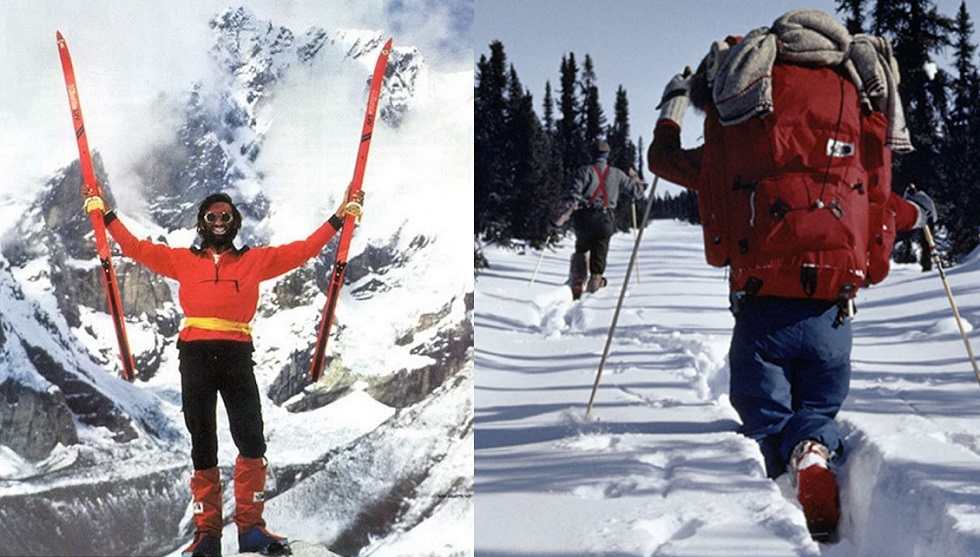
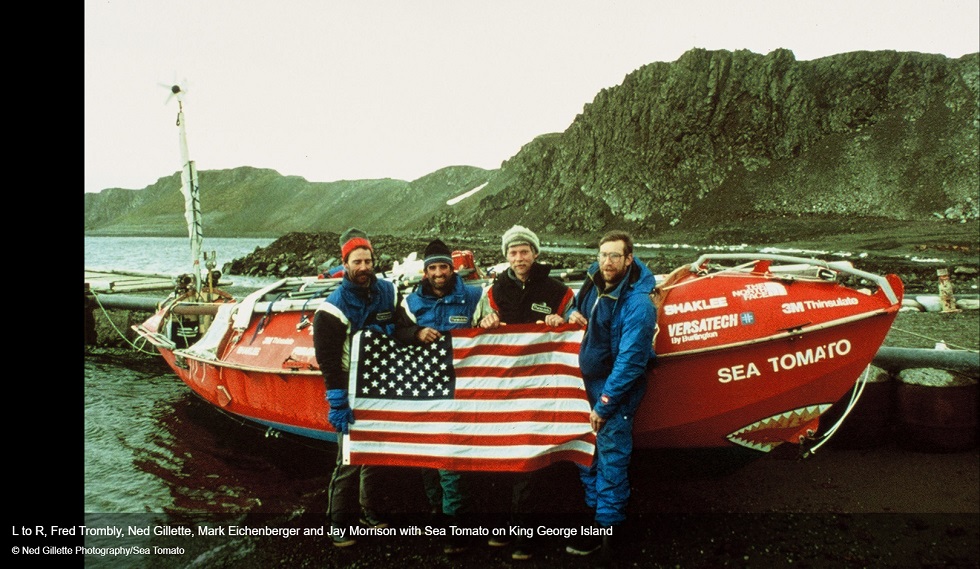
Gillette was not a man who did things quietly. An NCAA cross-country ski champion for Dartmouth in 1967, he went on to make the first one-day ascent of Denali with Galen Rowell in 1978, complete the first 500-kilometer ski crossing of the Karakoram in 1980, and circumnavigate Everest on foot and ski between 1981 and 1982. He rowed across the Drake Passage to Antarctica in a bright red rowboat called the Sea Tomato in 1988. He was, by any measure, a man who went to places — and he needed a bag that could keep up.
“Mule assisted. Yak assisted. Back of jeeps. Float planes,” says Szekeresh. “Sort of like travel that needs to happen to get to the start of the expedition is kind of how it started.”
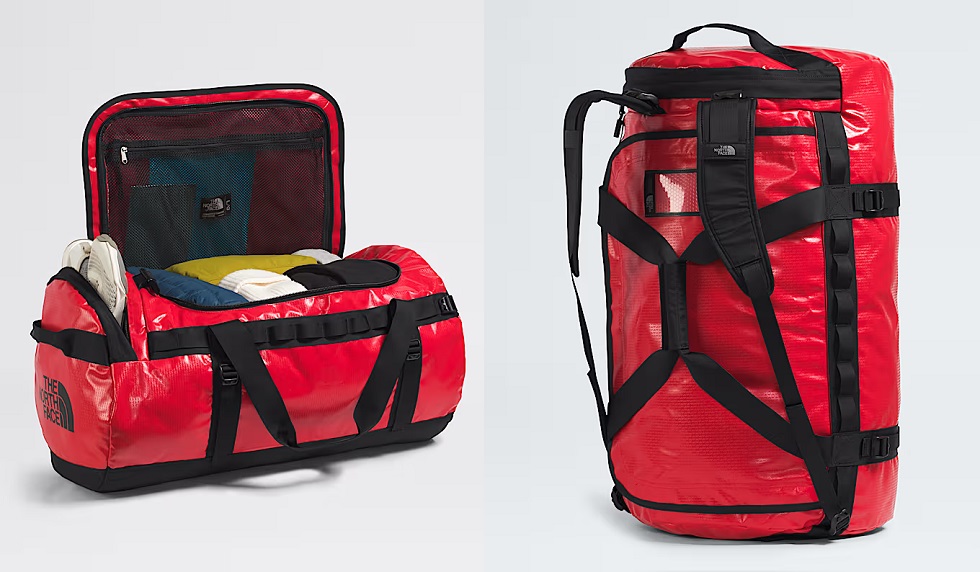
The original duffel launched in XL and double XL. The sizing logic was almost comically direct: if you’re going to base camp, you have a lot of stuff. The construction was equally unambiguous. A thousand-denier double-sided coated material — heavy, stiff, impervious, the textile equivalent of a tarpaulin — formed the body. Daisy chains ran the length of the exterior for lashing gear. Box stitching reinforced every stress point. The zipper was large and confident. The handles were built to be grabbed by cold hands wearing gloves.
There was no design language being established. There was no brand vocabulary being codified. There was just a machinist’s logic applied to a carry problem: what does this thing need to do, and what is the most direct way to make it do that?
The answer turned out to be timeless.
The Material Is the Product
Forty years later, the Base Camp Duffel is made from essentially the same stuff.
That’s not an accident. It’s the result of a design team that has spent four decades trying to improve on the original and repeatedly arriving at the same conclusion.
“We always try it,” Szekeresh says, “and we’re like — it just doesn’t feel the same, doesn’t hold up to the standard.”
The 1000-denier coated construction has been updated in the ways that matter — the PVC is now phthalate-free, the product is PFAS-free, the production process has been made progressively cleaner — but the fundamental material logic has not moved. The coated face gives the bag its characteristic look and feel: that slightly waxy, slightly stiff hand that softens with use and develops a patina that other materials simply cannot replicate.
“The coated material was just such a fan favorite in terms of the water resistance of it,” Szekeresh explains, “and then having the substrate be a thousand denier — it’s really durable.”
In an industry that has spent forty years chasing lighter, packable, and more technical, The North Face’s most enduring equipment product has held its ground on a heavy, stiff, coated nylon that would look at home on a fishing boat. The material is not incidental to the product. In many ways, the material is the product.
The Education of an Icon
For the first decade or so, the Base Camp Duffel was simply a very good expedition bag. It did what it was designed to do. Athletes used it. Expeditions relied on it. It went to places most bags don’t survive.
Conrad Anker has used the Base Camp Duffel on every single expedition he has undertaken with The North Face. Every one. That is a list that includes the 1999 Mallory and Irvine Research Expedition on Everest — during which Anker became the first person to locate George Mallory’s body, 75 years after the British climber disappeared near the summit — three Everest summits in total, the first ascent of Meru’s Shark’s Fin with Jimmy Chin and Renan Ozturk in 2011, and dozens of expeditions across Patagonia, Antarctica, the Karakoram, and the Alaska Range spanning nearly four decades. He served as team leader of The North Face climbing team for 26 years.
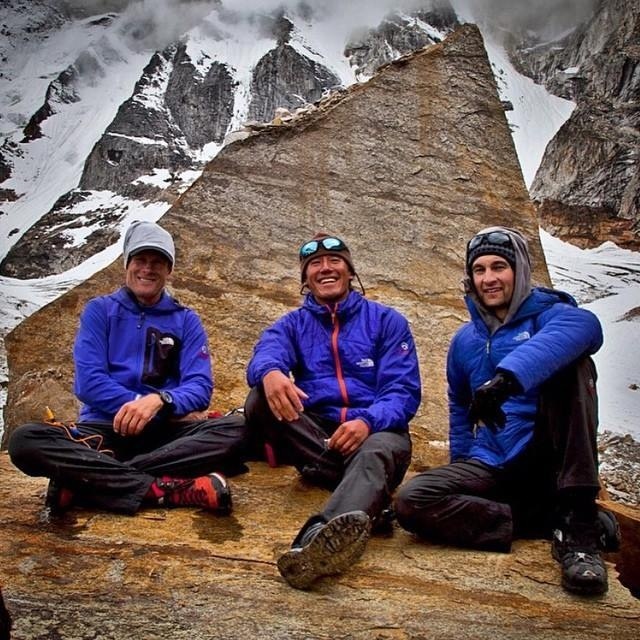
“He’s literally used it on every single expedition because it is the go-to piece,” Szekeresh says. “And some of his bags are — I think he’s traded them for like everything from yak rope to like who knows what.”
There is something quietly extraordinary about that detail. A bag so trusted, so embedded in the logistics of serious expeditions, that it becomes a form of currency at altitude. Because it’s useful — and useful in a context where useful is everything.
But the bag’s journey from expedition tool to cultural object happened through a different kind of accumulation. The North Face, for years, simply did not touch it. They resisted the temptation to update it, modernize it, or make it more of the moment. And that restraint — that principled refusal to improve what didn’t need improving — is what created the conditions for something unexpected to happen.
“Because it was untouched,” Szekeresh says, “it started becoming an icon.”
The Most Photographed Bag in the World
There is a photograph you have seen a thousand times without knowing it.
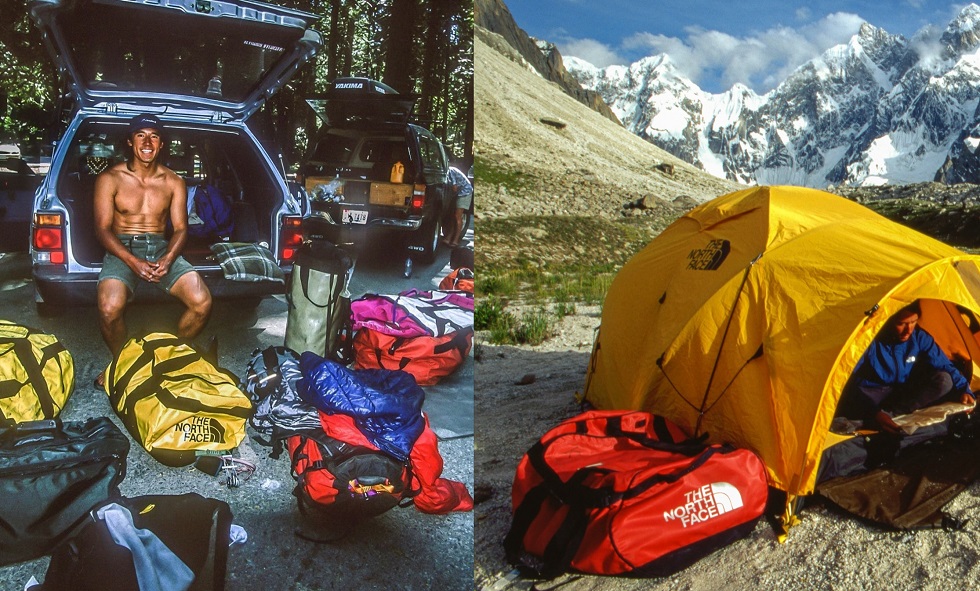
The composition varies. Sometimes it is a climber on a ledge in Patagonia, ropes coiled, the valley dropping away behind them. Sometimes it is a kayak pulled onto a gravel bar in Alaska, a fire going, the light going gold. Sometimes it is the back of a jeep in Namibia, or a float plane dock in British Columbia, or a base camp in Nepal with prayer flags snapping in the wind. The details change. One thing doesn’t.
In the foreground, or the background, or slung over someone’s shoulder, or sitting in the dirt doing nothing in particular — there is a Base Camp Duffel.
This is not a coincidence. It is the inevitable consequence of a bag that went everywhere serious adventurers went, for forty years, during the precise era when adventure photography became a global cultural force. The North Face built one of the most formidable athlete rosters in outdoor history — and those athletes took their bags with them. To the summits. To the walls. To the rivers and the ice caps and the desert ranges. Conrad Anker on Everest. Jimmy Chin on Meru. Alex Honnold somewhere vertical and terrifying. Hilaree O’Neill on Manaslu. The images that defined what adventure looked like for a generation almost always had a Base Camp Duffel somewhere in them.
The Collaborations
The first outreach came from Supreme.
Roughly twenty years ago, Supreme — then the most culturally attuned streetwear brand on the planet, with a gift for identifying objects that carried genuine weight and recontextualizing them for a new audience — came to The North Face. The Base Camp Duffel was among the first products they worked on together, making it one of the earliest North Face collaborations of any kind.
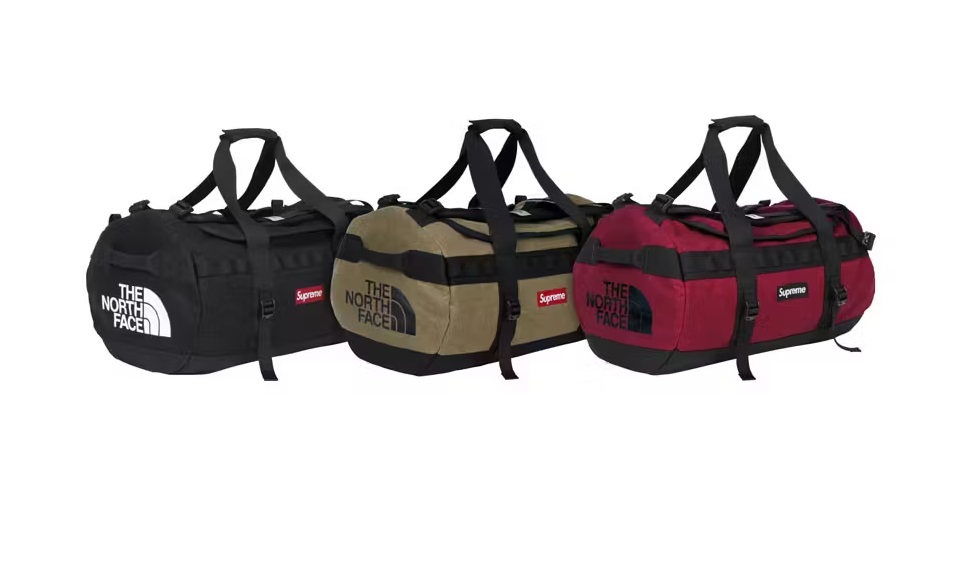
It was an early lesson in what the bag had become. Supreme doesn’t collaborate with things that are merely functional. It collaborates with things that carry meaning — objects with enough history and credibility that putting a box logo on them feels like recognition rather than appropriation.
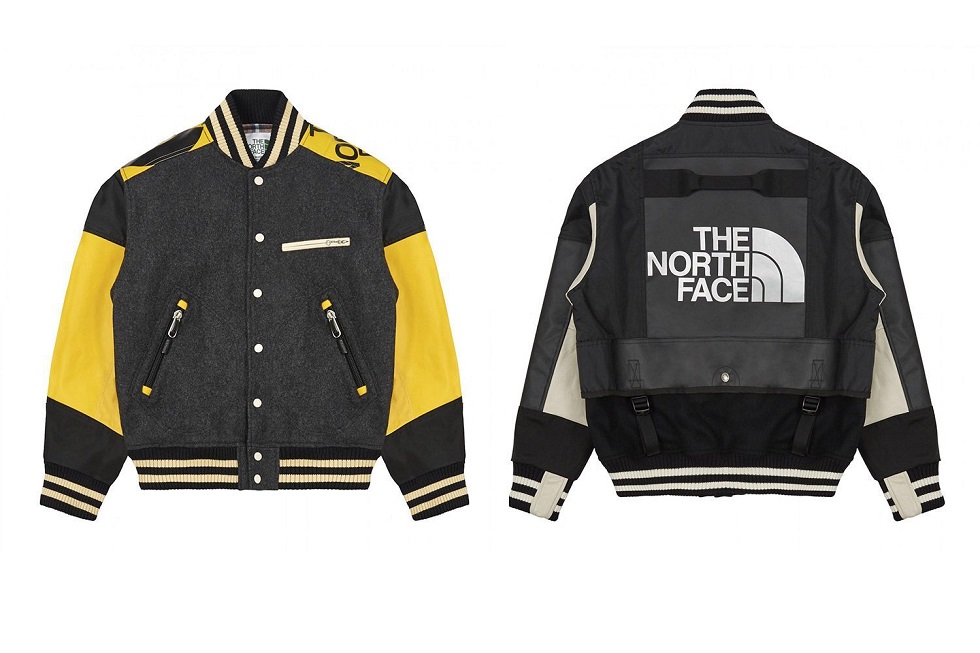
The collaborations that followed traced the bag’s expanding cultural footprint. Cecilie Bahnsen brought her signature sculptural femininity to it. Junya Watanabe took the Base Camp fabric and built it into apparel — coach’s jackets, outerwear. The tarpaulin material that had spent decades being dragged through base camps was appearing on Paris runways.
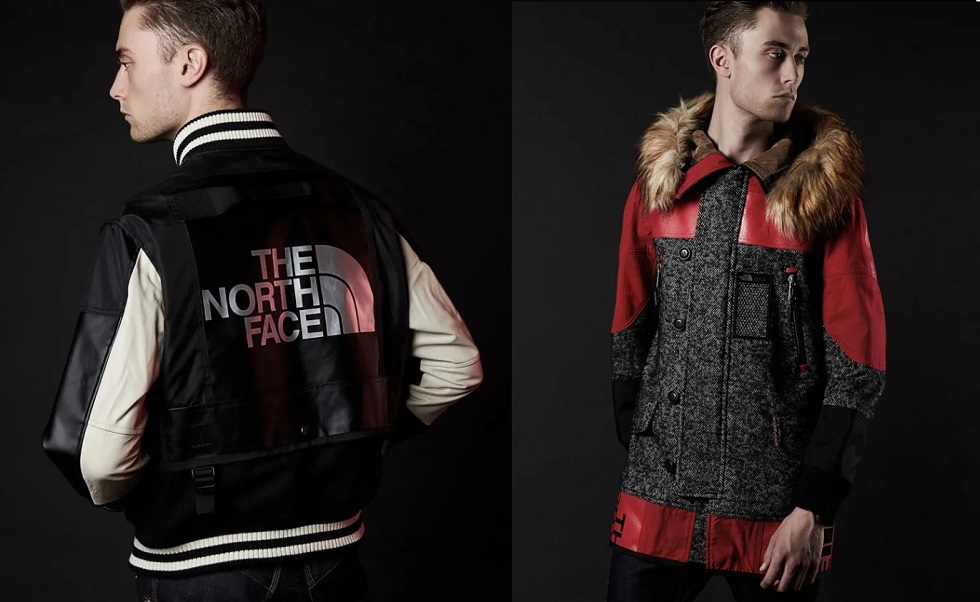
“When you started seeing it going on apparel,” Szekeresh recalls, “that was kind of an unlock for me where I was like, oh, this is for real.”
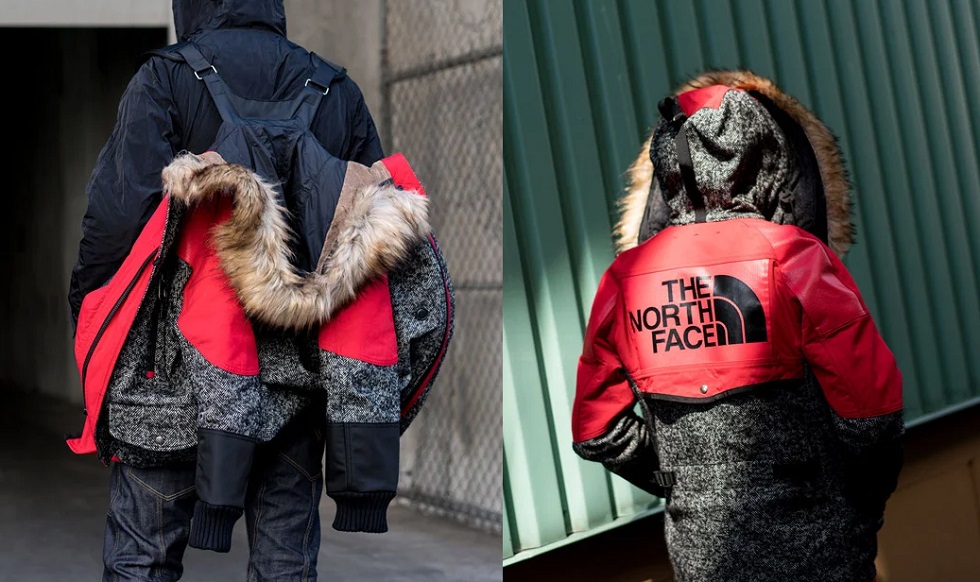
And through all of it, the bag itself never changed. The Supreme collaboration did not alter the construction. The Junya Watanabe coach’s jacket made from Base Camp fabric did not change what the bag was.
The Lesson of the Handles
Every icon has a moment where someone tries to improve it and learns, quickly and painfully, that they were wrong.
For the Base Camp Duffel, that moment involved the handles.
At some point in the bag’s history, the design team made a decision that seemed reasonable: on the smaller sizes, the traditional duffel handles would be replaced with briefcase-style webbing. Cleaner. More refined. More contemporary.
The response was immediate.
“We tried to take some of the handles off some of the really small ones and then there was just like an uproar,” Szekeresh says. “That lasted for a season or two and then we threw it back on — and that was kind of the learning to be like, okay, we can’t change the icon.”
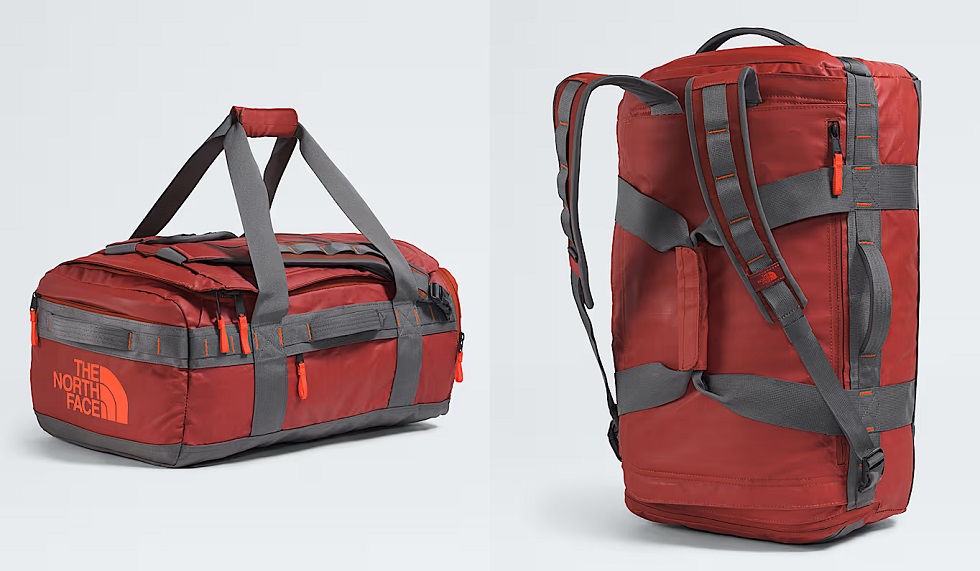
The lesson was absorbed. When the design team wanted to explore new features — side zipper pockets, end-cap organization, updated hardware — they did so carefully, incrementally, and always in service of the bag’s original logic. Even the packaging evolved thoughtfully: the most recent iteration sees the bag zip into a mesh stuff sack that doubles as an internal organizer — a small, considered detail that adds function without touching the form.
And when they wanted to experiment more radically, they built a pressure valve: the Base Camp Voyager line, a separate product that could carry the learnings from the original without touching the sacred thing itself.
“That was kind of the premise for creating the Voyager — creating a whole new thing that took some of the learnings from the Base Camp Duffel but then expanded on it and wasn’t sacred.”
A Design Language That Travels
The Base Camp Duffel is one of seven icons that The North Face considers foundational to the brand — alongside the 2 Meter Dome tent (1975), the Mountain Jacket (1985), the Denali fleece (1989), the Nuptse (1992), the Himalayan Suit (1994), and the ThermoBall Mule. Two of those seven are equipment. That’s not a coincidence.
The daisy chains. The box stitching. The coated tarpaulin construction. These details have become a transferable vocabulary — a design language that The North Face can apply across categories without losing the thread of what makes the original feel like itself.
“Anytime we apply that same ethos and philosophy to everything we do — whether it’s a Borealis backpack or a cross body — it feels like us and people resonate with it,” Szekeresh says.
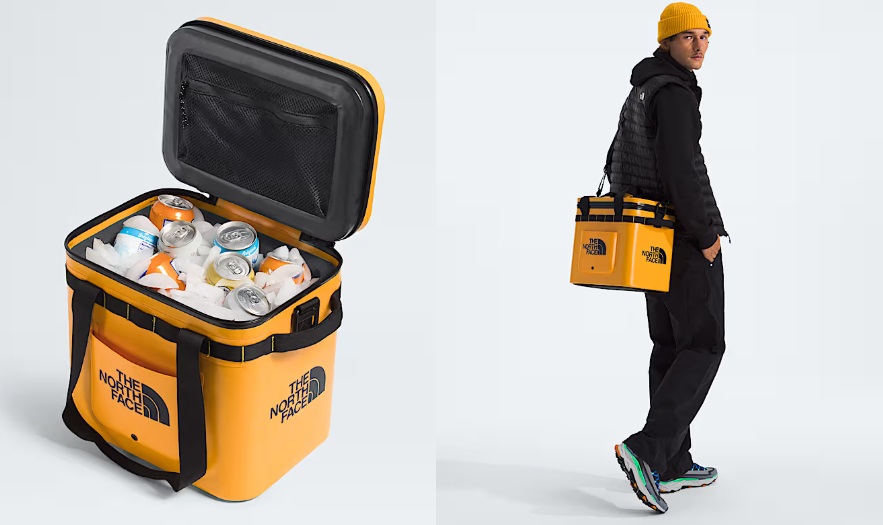
The most striking example is a fully welded cooler built using Base Camp design language. Same daisy chains. Same box stitching. Same tarpaulin aesthetic. A hard good, not a soft one — a completely different product category — and yet unmistakably, immediately, North Face.
Forty Years
The 40th anniversary of the Base Camp Duffel could have been many things. A redesign. A relaunch. A technical upgrade. A moment for the design team to finally make the changes they’d been holding back.
It is none of those things.
“I don’t want to be the star of the show,” Szekeresh says. “I want the history of the product to be the star of the show.”
That instinct shaped everything about the anniversary approach. The centerpiece is not a new material or a new silhouette. It is Conrad Anker’s notebooks.
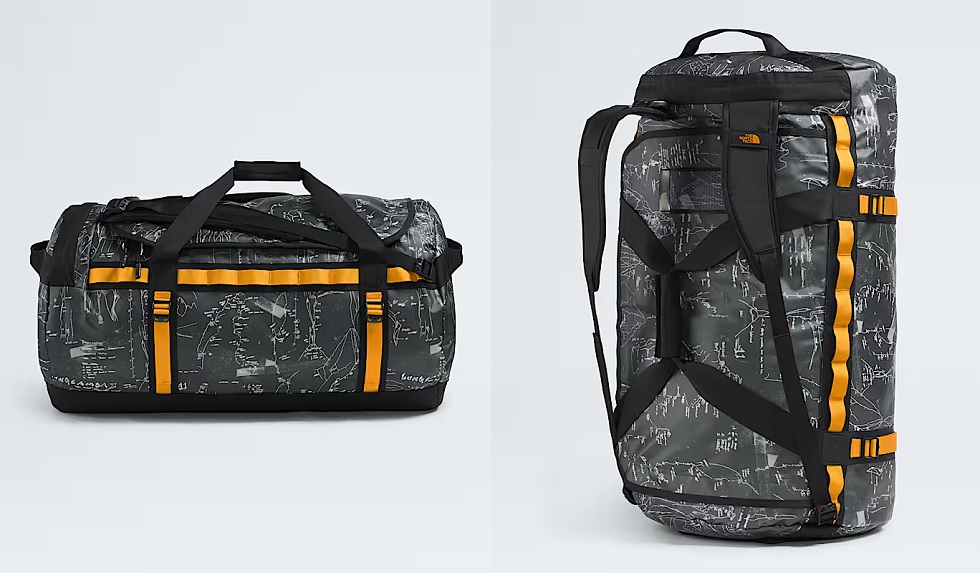
Over nearly four decades of expeditions, Anker has kept meticulous notes on climbing routes — what climbers call topos: hand-drawn diagrams that map a route’s logic, annotated with beta, hazard notes, and the accumulated knowledge of a life spent reading terrain. For the anniversary, those notes have been worked into a repeat print in collaboration with artist Allison Vest — Anker’s handwriting, his route diagrams, his margin notes, tiled across the duffel’s surface. Available across the S, M, and L sizes in Summit Gold, it is the history of the product made visible. The bag that went on every expedition, printed with the notes from those expeditions.
“It’s all of his notes and notebooks over his 40 years with the brand kind of put into a repeat and put into a print,” Szekeresh says.
Alongside the topos print, the anniversary collection pushes the duffel into new material territory with two special editions.
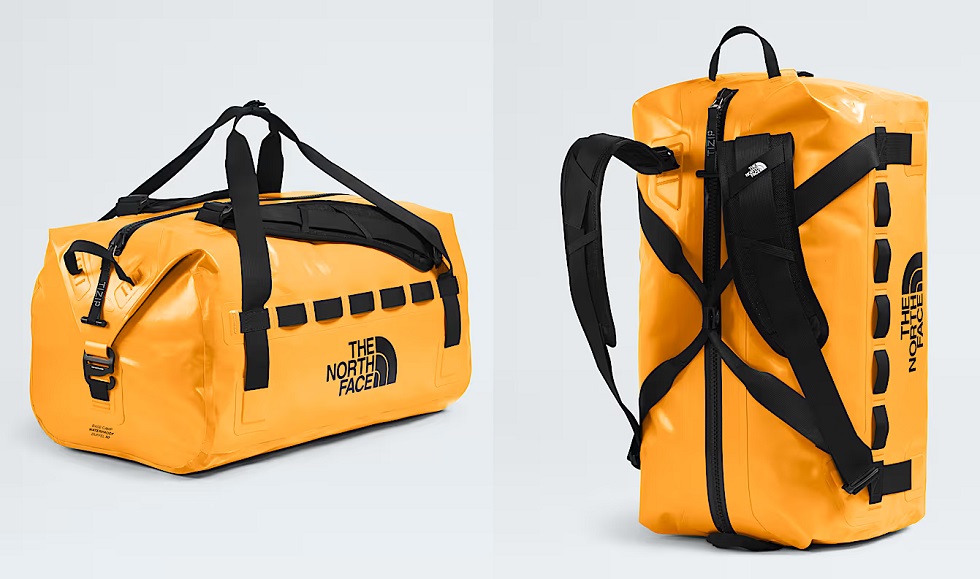
The Base Camp Waterproof Duffel 50L ($320) takes the bag’s inherent water resistance to its logical conclusion. The body is rebuilt in 1000-denier recycled polyester with a full TPU coating throughout, the construction is fully welded, and the zippers are waterproof. The result is a bag you can submerge — not a bag that will probably be fine in the rain. The silhouette is unchanged. The daisy chain remains. What has changed is the promise.
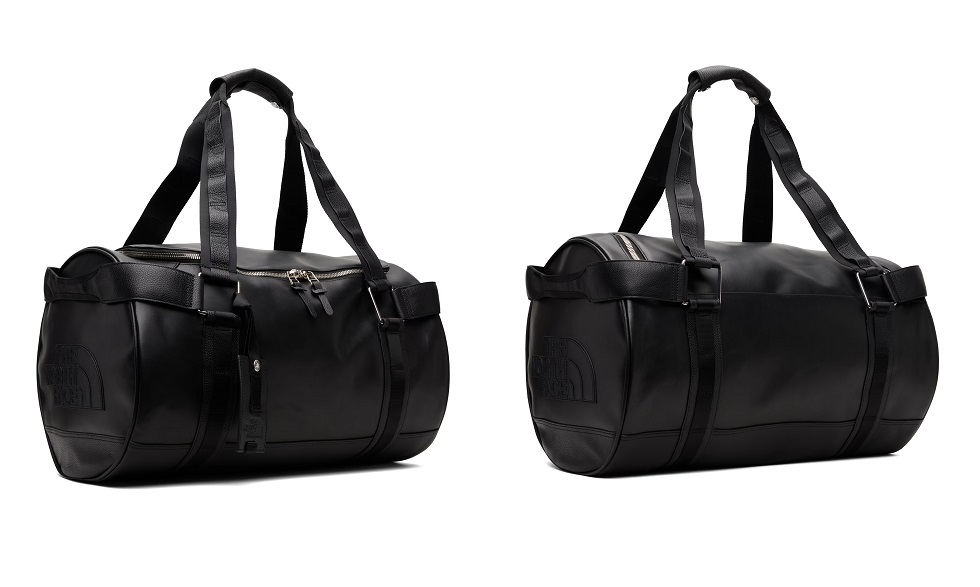
The Base Camp Duffel Leather is a different kind of argument. The PVC-coated polyester is replaced with full-grain leather across the body, handles, shoulder strap, and zip pull. The daisy chain lash points remain — a quiet nod to the bag’s origins — but the compression straps and end-cap pocket are gone, the priorities reordered toward urban travel and everyday carry. Limited to 900 individually numbered examples, available through Haven and Ssense from $621, with an Asian market release planned for June 1. It will not go to base camp. It was not designed to. But it makes a compelling case that forty years of refinement produces bones strong enough to carry almost any material you dress them in.
What Forty Years Actually Means
There is a version of this story that is about product design. About material choices and construction details and the wisdom of restraint.
There is another version that is about culture — about how an object moves from expedition logistics to streetwear to runway to anniversary edition, accumulating meaning at every stop without losing the thread of what it originally was.
Both versions are true. But the more interesting version might be about something simpler.
The Base Camp Duffel has lasted forty years because it was designed to solve a real problem, with honest materials, by people who understood what the problem actually was. It was never designed to be iconic. It was designed to get Ned Gillette’s gear to base camp without costing a fortune in airline fees.
Gillette himself never got to see what the bag became. He was killed in 1998, shot by bandits while sleeping in his tent in Pakistan’s Haramosh Valley, on an expedition to circumnavigate Nanga Parbat with his wife. He was 53. The plane tickets for his next trip were still in a drawer in his desk.
The bag he inspired outlived him by decades and shows no signs of stopping. That utilitarian clarity — that refusal to be anything other than what it needed to be — is what gave it the durability to become something more. You cannot manufacture that kind of longevity. You can only create the conditions for it and then, crucially, have the discipline not to get in its way.
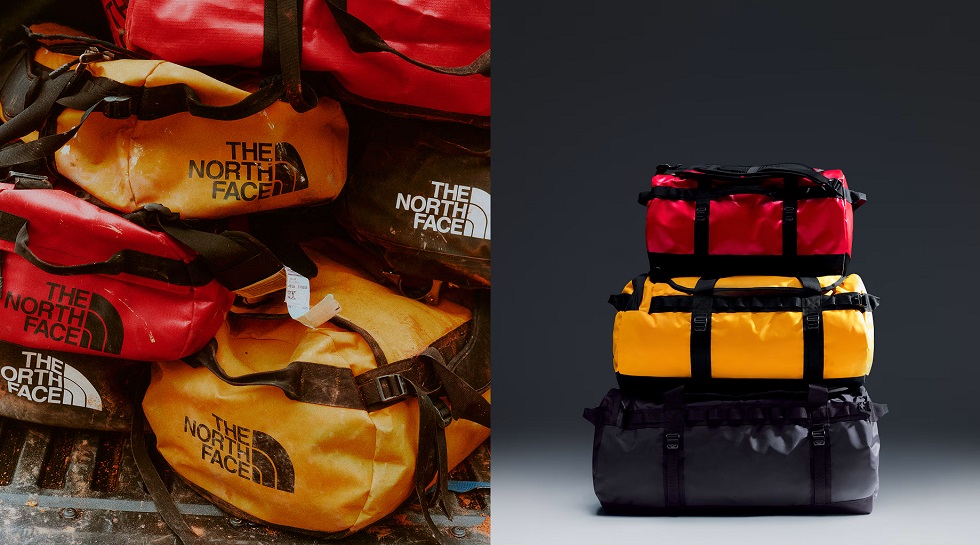
The North Face Base Camp Duffel 40th Anniversary collection — including the Waterproof Duffel 50L ($320, thenorthface.com), the Leather Edition (limited to 900 pieces, from $621 at Haven and Ssense), and the Conrad Anker Topos Print series — is available now.


Michael Knispel
Editor-In-Chief
Mike’s our editor-in-chief, storyteller, and master traveler. He’s been at the helm for over a decade, spearheading our stories, partnerships, and brand at large.



 WAYS TO CARRY