



 Carry Awards
 Insights
 Liking
 Projects
 Interviews
 Carry Candy
 Community and Marketplace
Industry
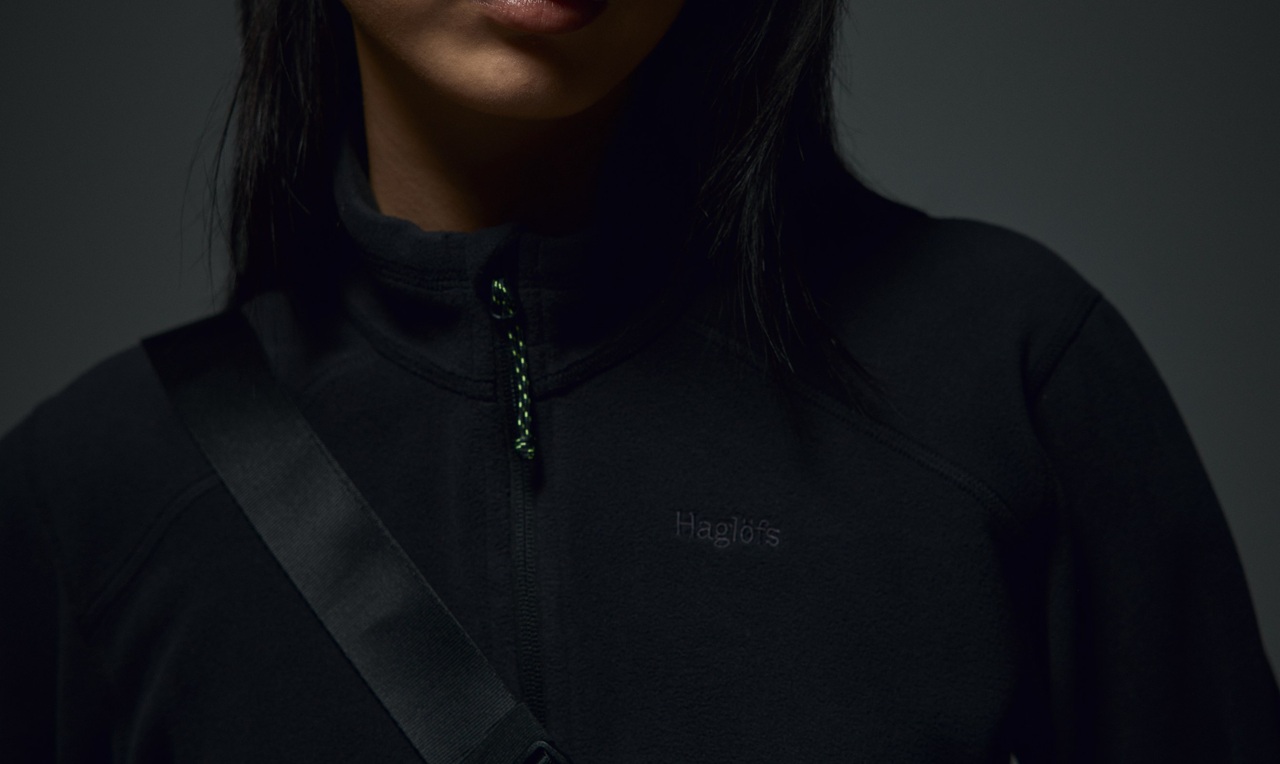
There is a problem hiding in plain sight in every outdoor gear store on earth.
Walk the fleece aisle of any well-stocked retailer and you will see it immediately. Because the problem is the color black.
Dozens of versions of it, hanging side by side, each one marginally different from the next in ways that only become visible when you hold two swatches together under good light.
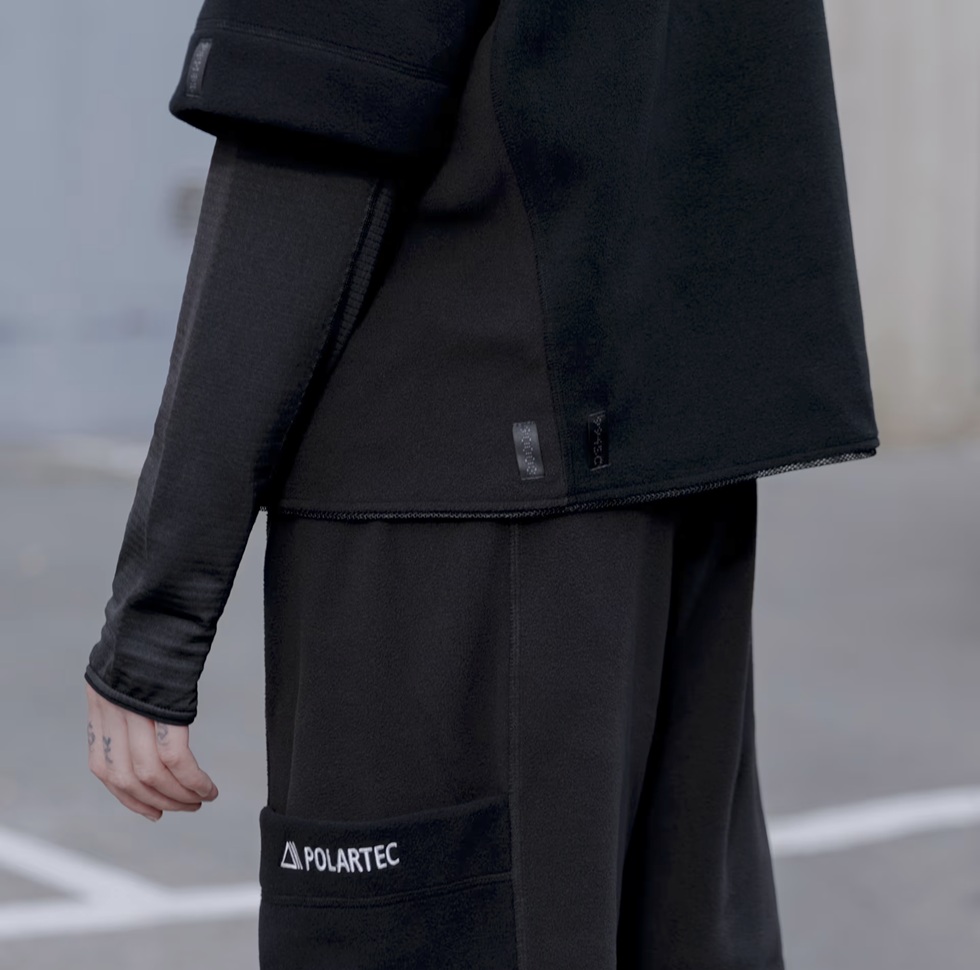
Look at the garment in the image above. Can you see it? The panels are all black. They are all Polartec fleece. They were all made by outdoor brands, for outdoor products, in the same season. And they are not the same color.
A hint more blue in one. A touch more warm in another. Now look more closely and you’ll see each panel on that garment carries a woven label stamped with its original color batch number. The batch numbers are there to make the point as plainly as possible: these are distinct, separately commissioned, separately processed, separately dyed runs of fabric.
The differences are real enough to see under direct light — but are they real or important enough to justify how they came to exist? Well, that’s a question that Haglöfs and Polartec are asking.
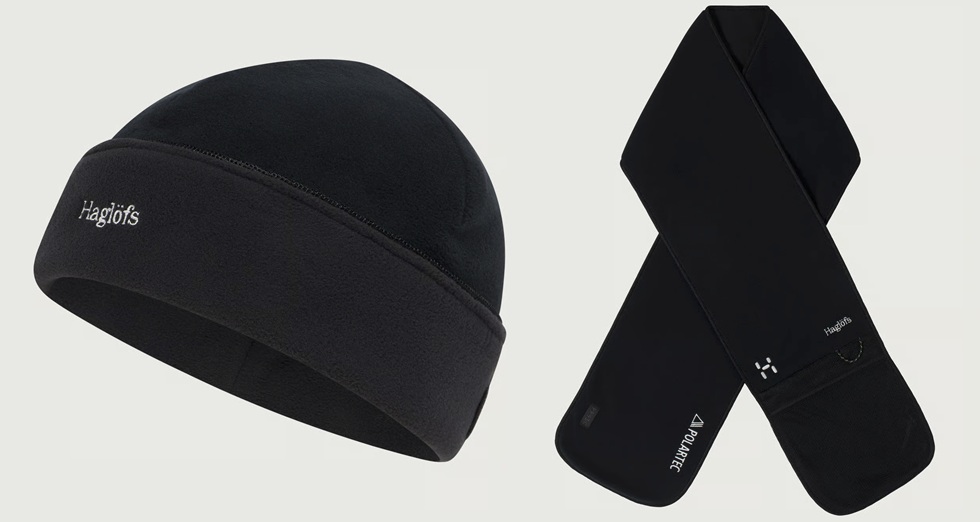
That garment is the Black Capsule Project Tee — one piece in a limited collection Haglöfs built from leftover black Polartec fleece in multiple variations, alongside a matching Beanie, Scarf and Pant, and they were made to make a point: the outdoor industry is running dozens of separate dye processes, consuming enormous quantities of water and energy, to produce shades of black that are, to all practical purposes, identical.
To the customer, these differences are invisible. To the brands that made them, each one represents a separate dye batch, a separate chemical mix, a separate minimum order quantity, and a separate environmental bill that nobody has been adding up.
Haglöfs and Polartec started adding it up. What they found is the kind of problem that is simultaneously obvious, significant, and almost entirely unaddressed. The question is whether the rest of the industry is ready to look at it.
The Dye Problem
To understand why black is a problem, you need to understand how textile dyeing actually works, and specifically how it works for synthetic fabrics like the polyester fleece that makes up the bulk of the outdoor industry’s mid-layer offering.
Polyester doesn’t absorb dye the way natural fibers do. Cotton and wool have an affinity for water-based dyes; you can dye them at relatively low temperatures with relatively modest chemistry. Polyester is hydrophobic. It repels water. To get color into it, you need a different class of chemistry entirely: disperse dyes, which are applied at high temperature — typically 130°C or above — under pressure, in a hot aqueous bath that forces the dye molecules into the polymer structure of the fiber itself.
The process is energy-intensive by nature. Heating large volumes of water to pressure-vessel temperatures and holding them there for the duration of a dye cycle is not a trivial energy ask. And black is the most demanding color of all. Achieving a deep, consistent, neutral black requires layering multiple disperse dye molecules together, each one contributing to the final shade. More chemistry. More fixation cycles. More water. More heat.
The textile industry accounts for roughly 20% of global industrial water pollution, with dyeing and finishing operations responsible for the largest share of that figure. A single kilogram of dyed polyester fabric can require between 30 and 150 liters of water to process, depending on the method, the depth of shade, and the efficiency of the facility. Black, as the deepest shade in any palette, sits at the demanding end of that range.
And here is the part that makes the outdoor industry’s specific version of this problem particularly absurd: every brand is running its own version of the same process, independently, to produce shades that are functionally indistinguishable to the people who wear them.
The Minimum Order Problem
There is an operational reason why this happens too. It has to do with minimum order quantities.
Dye houses work in batches. To run a dye cycle economically, you need a minimum volume of fabric — typically several hundred kilograms at a minimum, often significantly more. If you want a specific shade of black, you commission a dye recipe, run a batch, and take delivery of your minimum order. If your volume is high enough, the economics work. If it isn’t, you’re paying a premium for a small run of a color that is, to all practical purposes, identical to the one your competitor just ordered from the same dye house.
The result is a system in which dozens of brands are independently commissioning dozens of marginally different blacks, each one requiring its own recipe development, its own quality approval process, its own batch run, and its own chemical and water consumption. The waste is not in any single decision. It is in the aggregate of hundreds of rational individual decisions that, taken together, produce an irrational collective outcome.
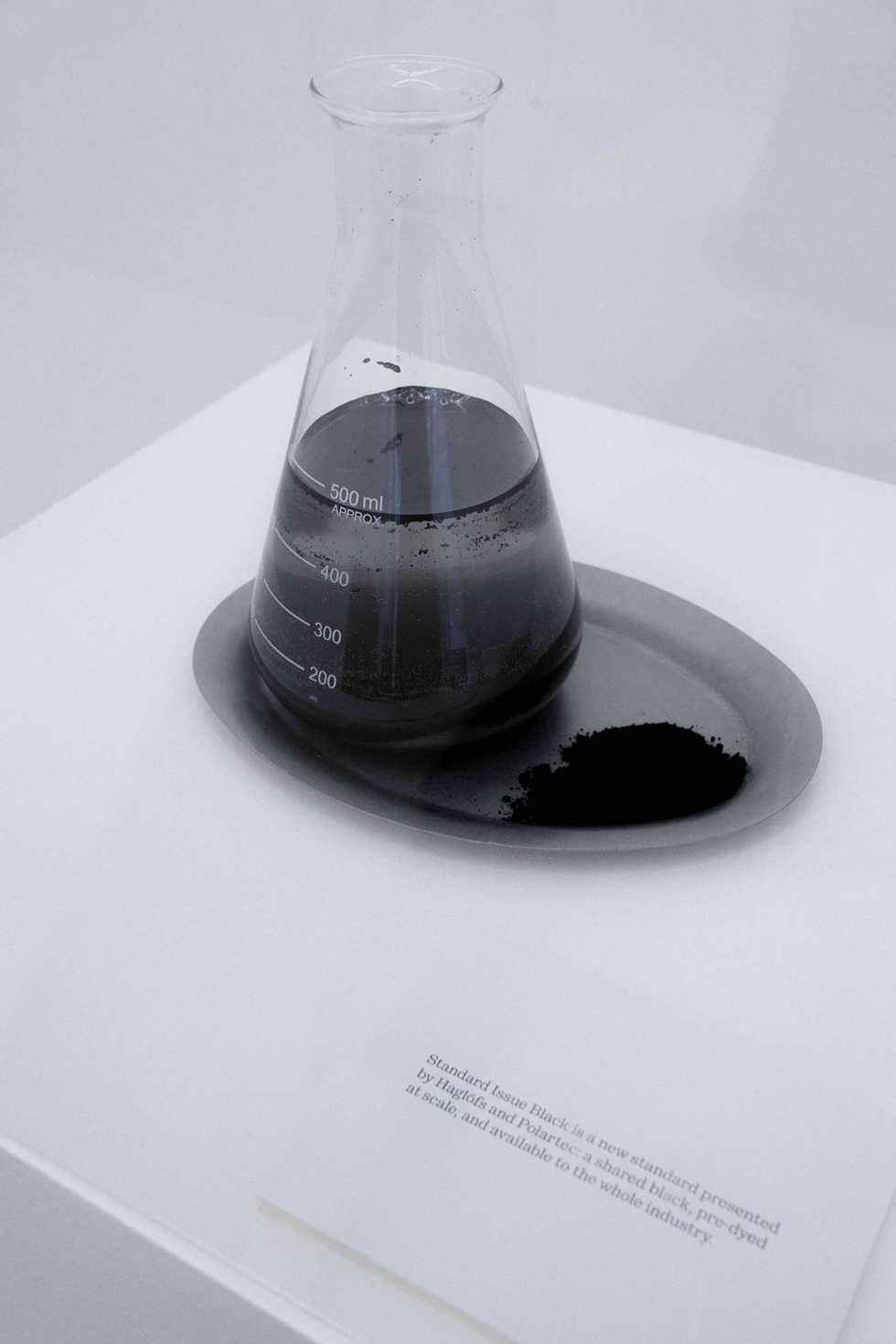
These are the problems that Standard Issue Black™ is designed to solve.
The Black Capsule
Before Haglöfs launched a product, they launched their argument.
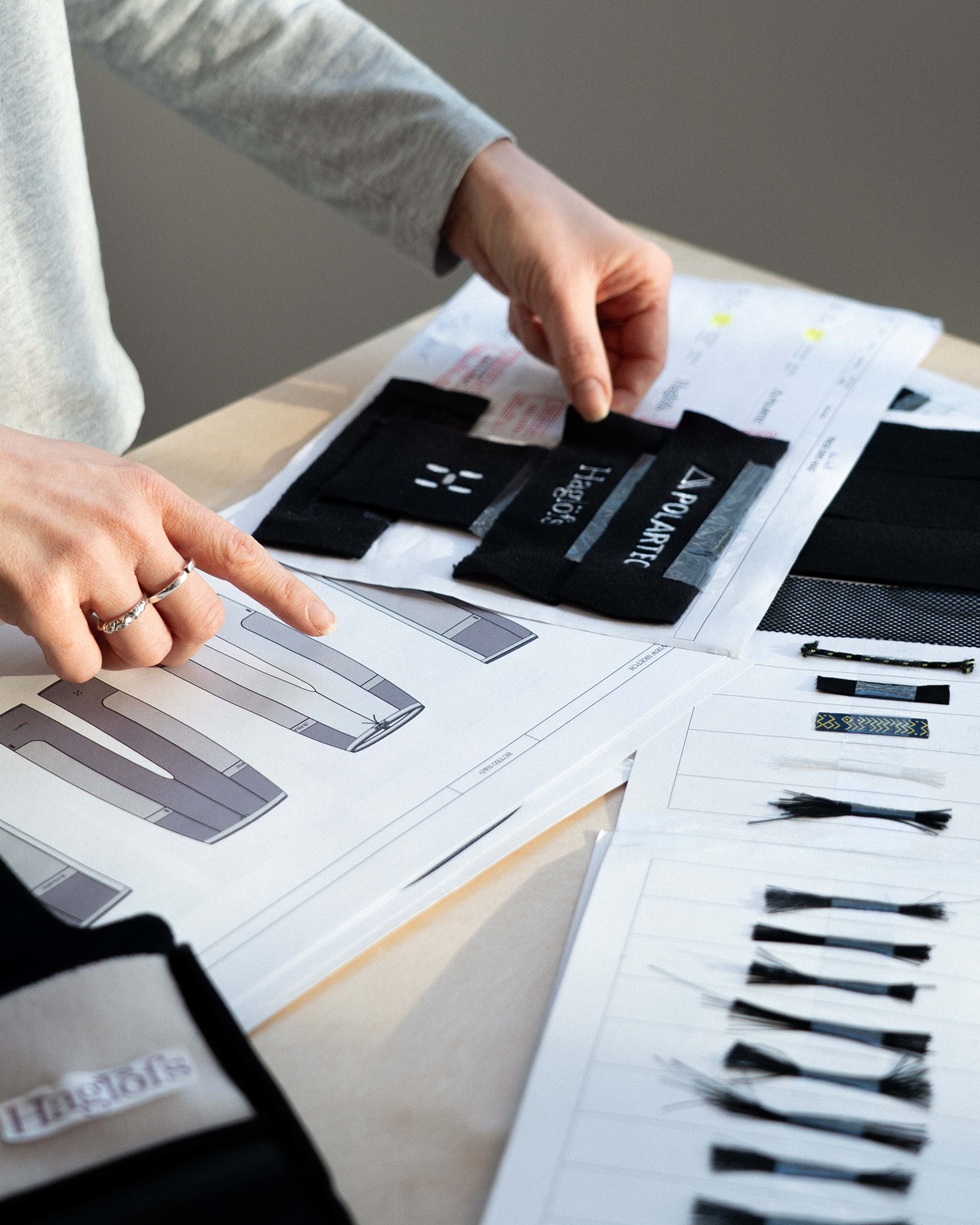
The Black Capsule collection — a limited run of a Project Tee, Beanie, Scarf, and Pant — is a direct piece of sustainability communication. Each garment is assembled from three distinct shades of leftover black Polartec fleece, stitched together as a single piece.
Every pattern piece on every Black Capsule garment carries a woven label stamped with its original color batch number. The number tells us exactly which dye run produced that panel — and by extension, exactly how many separate dye runs were required to produce the variation you are holding in your hands.
A Universal Black for the Industry
The solution that follows from the Black Capsule is, in concept, almost aggressively simple. Haglöfs and Polartec agreed on a single shade of black, had it dyed at scale by Polartec as part of their standard production process, and made it openly available to the entire industry. No proprietary lock-in. No licensing fee. No competitive advantage withheld. One black, shared to everyone who wants and understands it.
The environmental arithmetic follows directly from the economics of scale. When you consolidate what would have been dozens of separate small-to-medium dye batches into a single large one, the efficiency gains are real and compounding.
Haglöfs’ internal production assessment puts the numbers at over 50% reduction in water use and at least 20% reduction in energy consumption compared to traditional piece-dyed black fabrics. These are company-supplied figures rather than independently verified ones — worth noting — but the underlying logic is sound. Batch consolidation is a well-understood lever in industrial chemistry. The gains are not surprising. What is surprising is that nobody did this sooner.
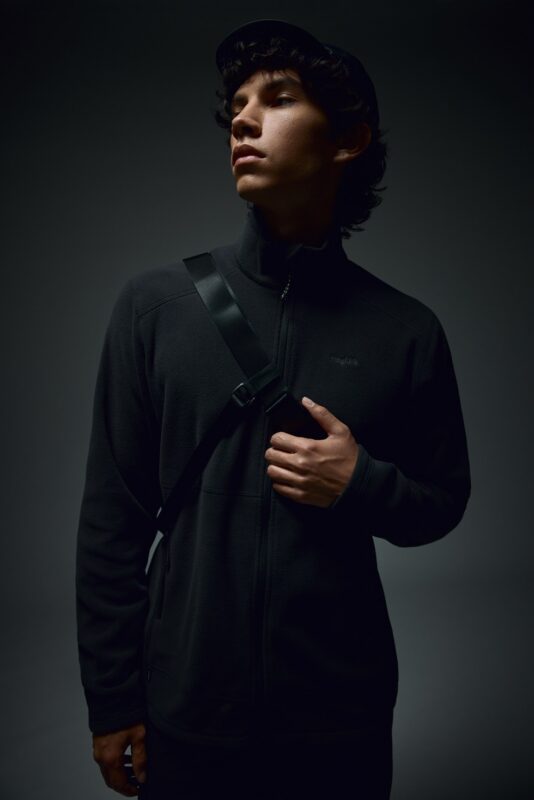
Standard Issue Black™ enters full production for the first time in Haglöfs’ FW26 season — the transition, as Haglöfs puts it, from concept to implementation.
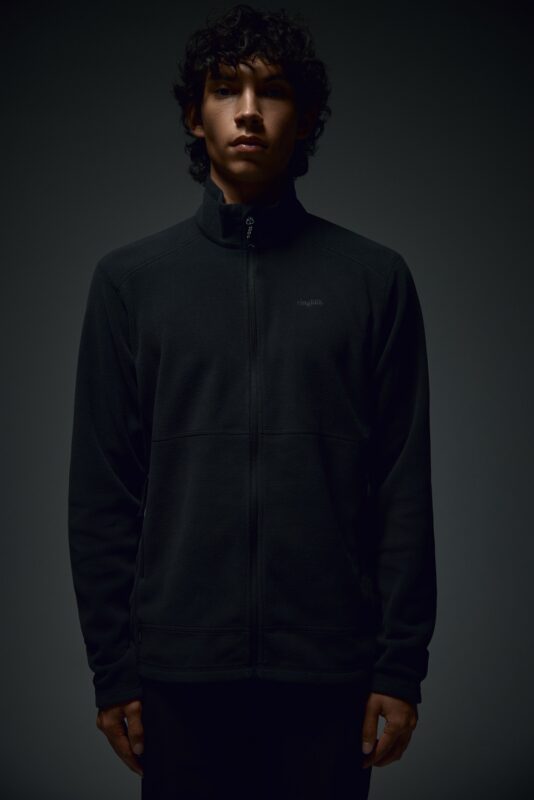
The Buteo Mid II Jacket is the first commercially available product built on this standard. It is, deliberately, not a concept piece. Haglöfs’ Head of Design and R&D, Eva Weiss, was explicit about the choice of vehicle: the Buteo is one of the brand’s higher-volume styles.
It is the kind of jacket that sells in quantity, which is precisely the point. The environmental case for Standard Issue Black™ only holds at volume. Putting it into a niche limited edition would have been a demonstration. Putting it into a bestseller is a different kind of statement.

The Creativity Question
The objection that will occur to every designer reading this is the obvious one: standardization kills creativity. If every brand uses the same black, everything looks the same.
It’s a reasonable concern.
Black has never been where outdoor brands differentiate themselves. The differentiation is in the cut, the construction, the hardware, the colorway story, the technical specification, the fit, the trim details, the logo placement, the seasonal accent colors. Black is the reliable and unchangeable constant.
Eva Weiss puts it well: “Standardization doesn’t have to limit creativity. With the right framework, it gives us the freedom to work together in the same creative direction and make a bigger impact. Having one defined black simplifies the design process, and brands could still differentiate themselves through other colors, cuts, and design elements.”
There is a parallel worth drawing. The outdoor industry standardized on a small number of zipper systems decades ago — YKK dominates the market so thoroughly that its presence on a garment is unremarkable. Nobody argues that YKK zippers have killed creativity in outerwear design. The standardization of a functional component freed up design energy for the things that actually matter. Standard Issue Black™ is making the same argument about color.
Will Other Brands Follow?
Here is what makes adoption genuinely uncertain: the outdoor industry has a long history of sustainability initiatives that are well-intentioned, carefully designed, and then quietly ignored by the brands that weren’t involved in creating them.
The “green premium” problem — the gap between what consumers say they value and what they actually pay for — has killed more promising ideas than any amount of regulatory pressure.
Standard Issue Black™ sidesteps that question entirely, because it doesn’t cost more. The economics are neutral to positive. The environmental case is clear. The creative objection might slow some down.
What remains is institutional inertia. The same force that kept the industry running dozens of separate black dye processes for decades when the alternative was obvious. The same force that Unspun is fighting with Vega, that BASF and VAUDE are fighting with ZeroPCF, that Gore fought with ePE. The machine keeps running because stopping it, even briefly, can be uncomfortable.
Standard Issue Black™ doesn’t ask anyone to stop the machine. It asks them to do less.
Whether that ask is simple enough to be answered — by enough brands, at enough volume, to make the standard mean something beyond Haglöfs’ own catalogue — is the question the Black Capsule raised and the Buteo Mid II is beginning to answer.






Michael Knispel
Editor-In-Chief
Mike’s our editor-in-chief, storyteller, and master traveler. He’s been at the helm for over a decade, spearheading our stories, partnerships, and brand at large.

 WAYS TO CARRY