



 Carry Awards
 Insights
 Liking
 Projects
 Interviews
 Carry Candy
 Community and Marketplace
In a world changing at breakneck speed, one corner of the fashion industry has remained fundamentally still. And it’s not the materials — those have transformed dramatically. Nor the marketing, the retail models, or the sustainability messaging. Those evolve season by season. What hasn’t changed is the thing that happens in the middle: the actual making of the clothes.
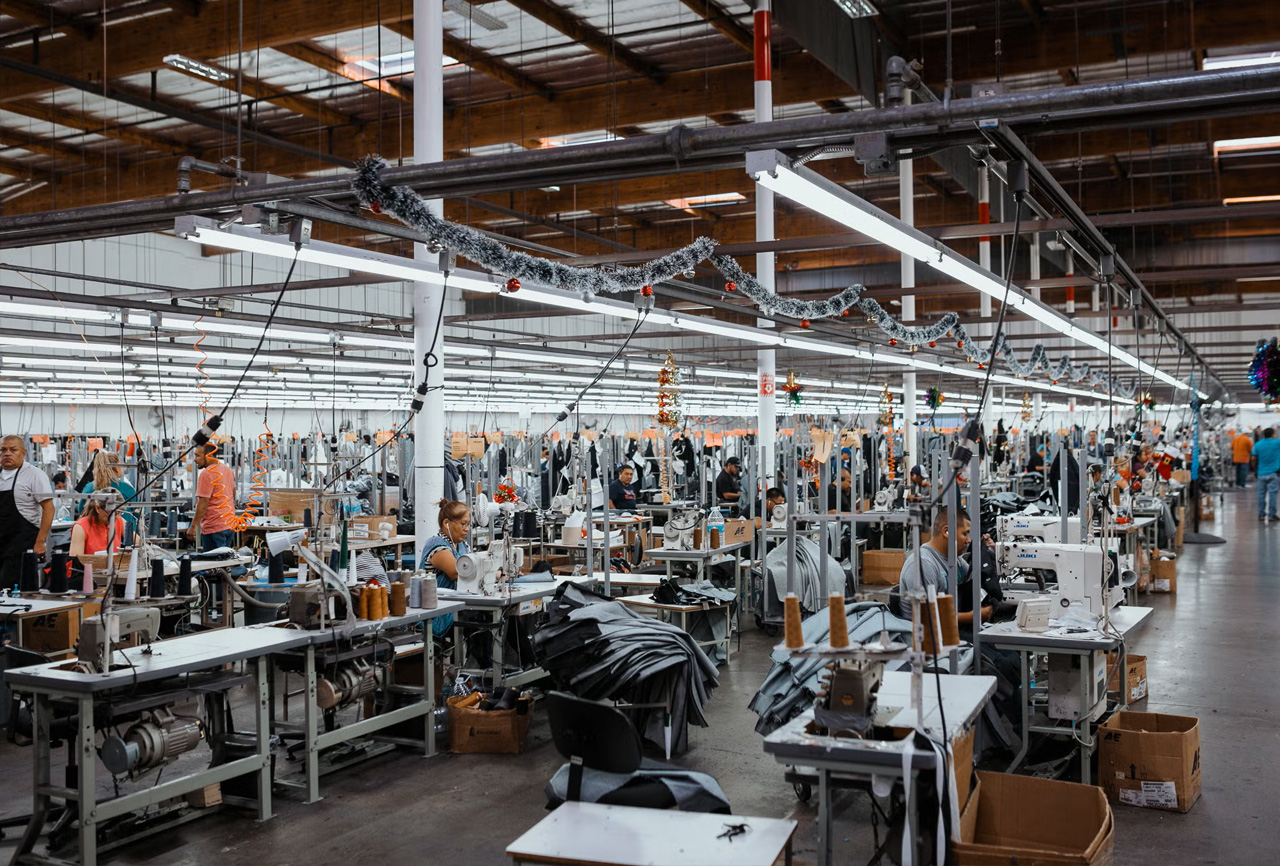
The process is called cut and sew. And in its basic form, it is the same process that clothed the industrial revolution.
Fabric is woven flat. Patterns are cut out. The pieces are shipped to a factory, where workers stitch them together, one seam at a time. The finished garment is packed, warehoused, and shipped — often across multiple continents — to a shelf stocked months in advance based on somebody’s best guess about what you might want to buy.
It is a system built for a world of cheap labour, long lead times, and acceptable waste. And the waste is enormous. Not just the 15 to 20 percent of fabric left on the cutting room floor — but the garments made before anyone wanted them, that sat in warehouses, got discounted, got liquidated, got burned. The fashion industry accounts for up to 10% of global carbon emissions annually. A significant chunk of that isn’t from what we wear. It’s from how speculatively it gets made.
For two hundred years, nobody has fundamentally changed that. Sustainable materials get value-engineered out. Ethical supply chains get undercut by cheaper ones. The machine keeps running because stopping it, even briefly, is expensive.
But a small startup in the Bay Area thinks it has built something that doesn’t ask the industry to stop. Just to swap out the machine.
But, you see, something similar has come before…
The Machine That Almost Changed Everything
The technology to do better has existed for decades.
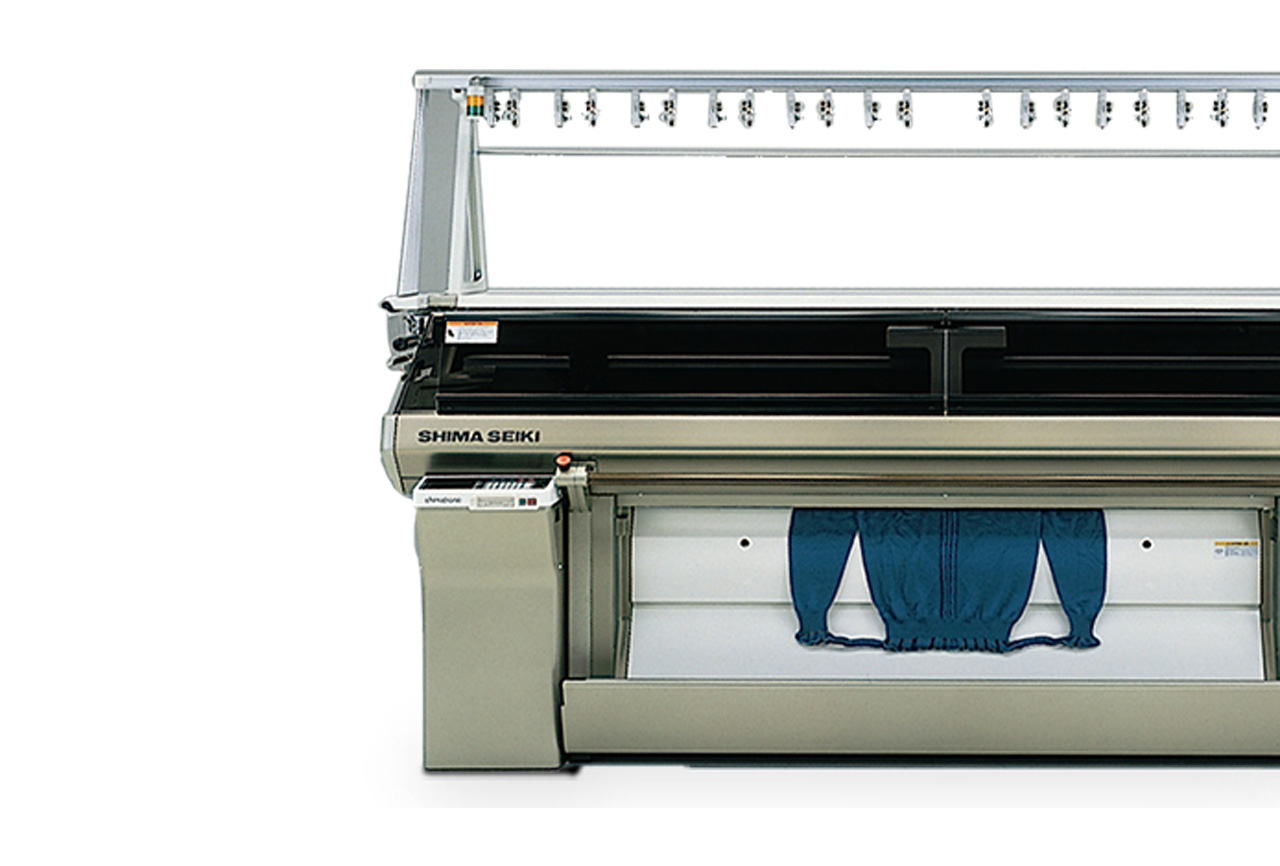
In 1995, Japanese company Shima Seiki introduced the WHOLEGARMENT® knitting machine — capable of knitting an entire garment in three dimensions in a single pass, with no panels, no seams, no skilled linking required. It built the garment in the round, shaping it as it went, with nothing left on the floor. In 2012, Nike used the same principle for the Flyknit upper, claiming to reduce manufacturing waste by 60% compared to conventional construction. A handful of luxury knitwear brands quietly adopted the technology for premium lines.
And then the broader industry moved on. The speculative, high-volume, low-margin model that drives most fashion has very little incentive to invest in a slower, more considered way of making things. The machine existed. The will to use it at scale did not.
The problem has been understood for thirty years. The solution has been sitting in Japanese factories for thirty years. What’s changed is who’s now trying to apply the same logic to the far larger, far more wasteful world of woven garments — the jeans, chinos, and trousers that make up the bulk of what the industry actually produces.
Meet Vega
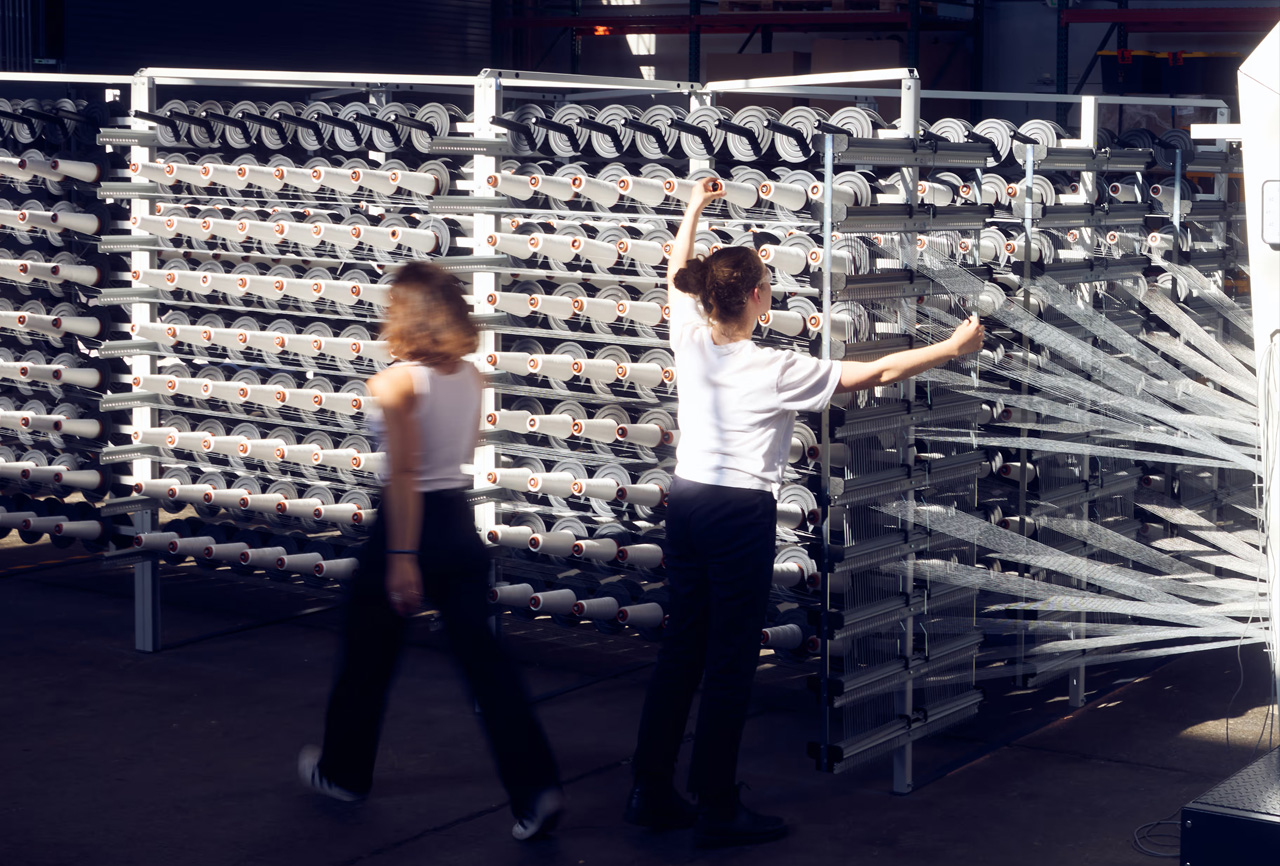
Unspun is a Bay Area startup that has spent years building a machine called Vega™. It takes thousands of individual yarns and weaves them directly into a finished, seamless three-dimensional textile. No cutting. No sewing. No eleven-step supply chain. Yarn goes in, trousers come out — in under ten minutes.
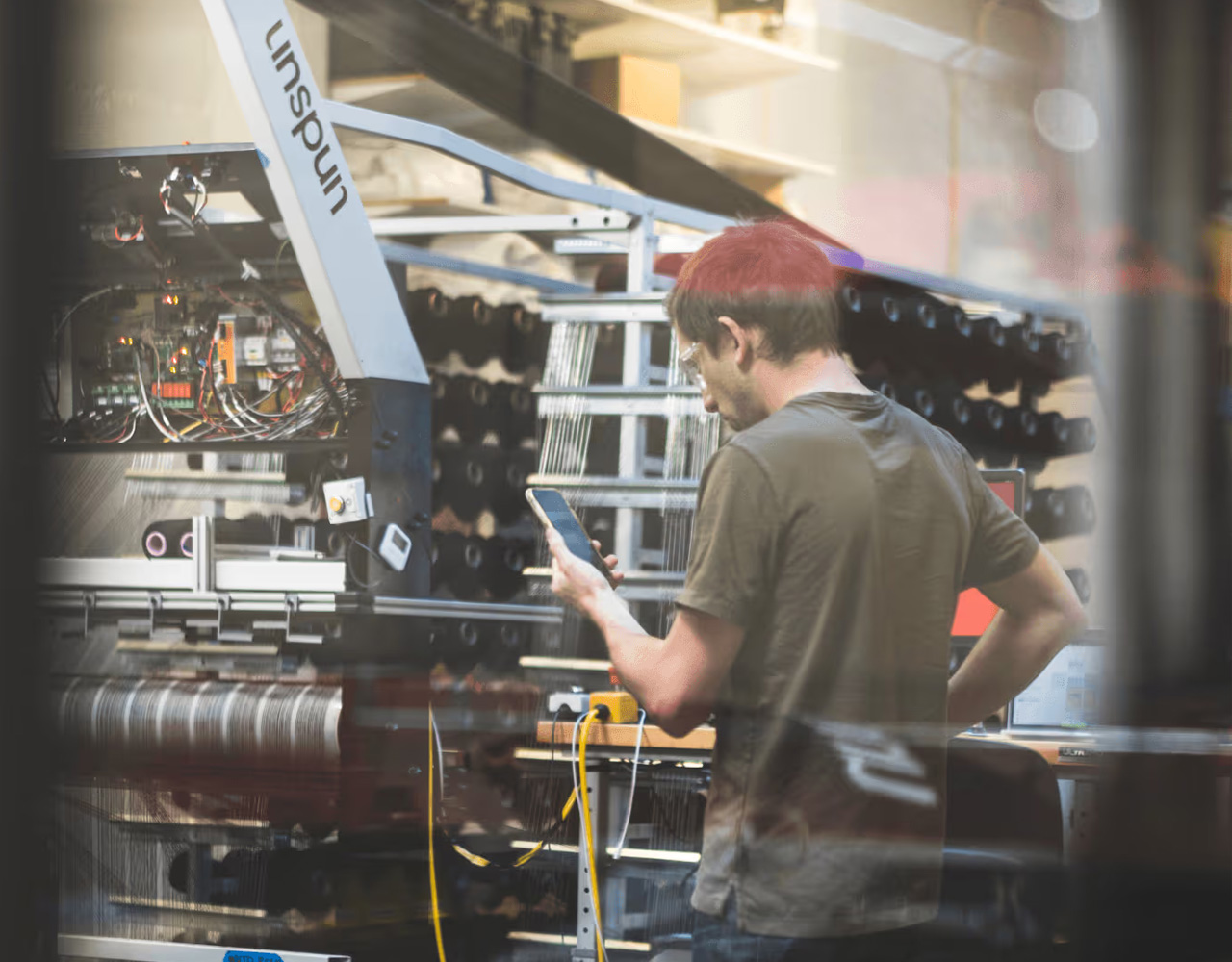
That’s the number worth sitting with. The conventional denim supply chain, from cotton field to finished jean, takes months and crosses the globe multiple times. Vega produces a finished woven trouser in under ten minutes, in a single location, from a single input.
Co-founder Beth Esponnette describes it simply: like a basket-making machine, but for clothes. Thousands of warp threads are routed into Vega’s weaving core, and the machine builds the garment in three dimensions directly from yarn — shaping it as it goes, rather than cutting shape from flat cloth after the fact. The result is a single continuous textile object, not an assembly of parts that have been cut, bundled, shipped, and stitched back together.
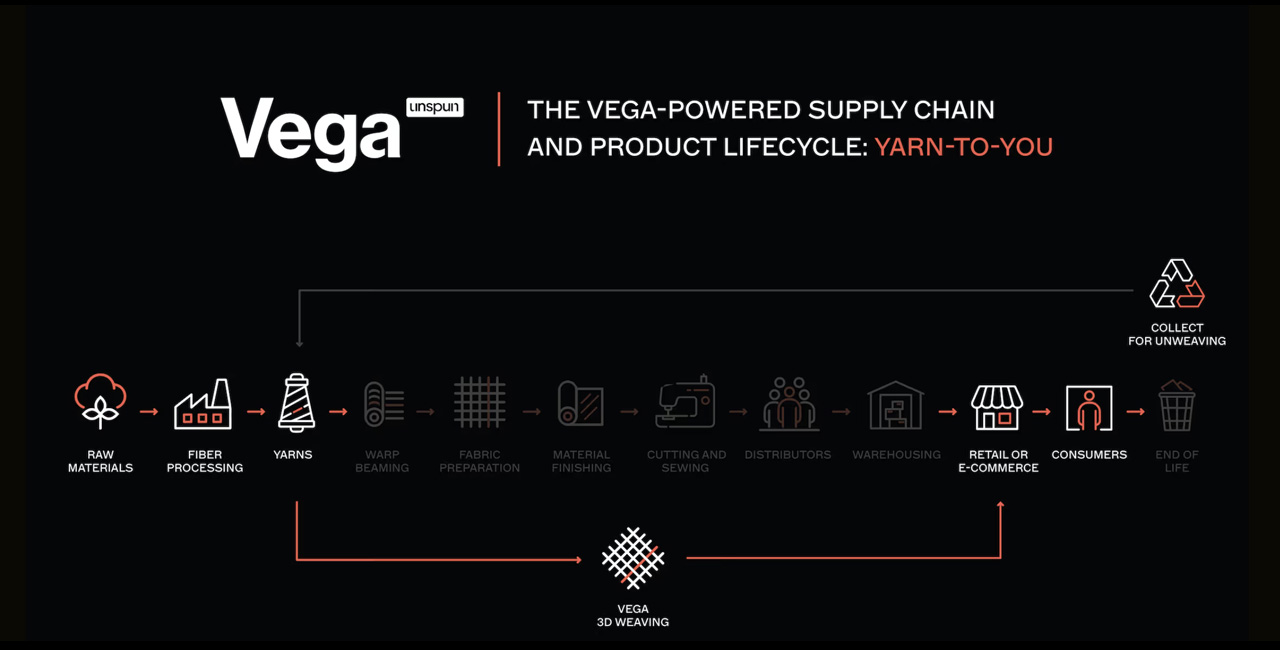
The structural difference is real. No leg seams makes the trouser stronger and lighter. Labels woven directly into the fabric means no itchy tag, no thread to unravel. And because the shape is built in from the start, the fit potential is significant. Unspun began its life as a custom-fit jeans company, using 3D body scans to produce made-to-measure denim. Vega is the manufacturing infrastructure that could eventually make that kind of personalisation available at scale.
The Numbers
Unspun commissioned a Life Cycle Assessment comparing a Vega-made cotton trouser to a conventionally manufactured equivalent:
53% lower global warming potential
49% lower primary energy demand
39% lower blue water consumption
Those gains don’t come from switching to organic cotton or recycled polyester. They come from collapsing the supply chain itself. No cutting waste. No overstock. No intercontinental shipping of half-finished goods.
Esponnette is clear that overproduction is the bigger villain. Brands have to guess well in advance what will sell, place enormous orders, and live with the consequences when they guess wrong. Vega attacks both problems at once: on-demand production means no overstock; no cutting means no offcut waste. You make what’s been ordered, when it’s been ordered, close to where it will be worn.

The circularity potential is also genuinely novel. Because Vega weaves rather than sews, the process is theoretically reversible. A worn-out garment could be unwoven, its yarns recovered and rewoven into something new — not downcycled into insulation or carpet, but actually rewoven. A closed loop, not just a less leaky version of the linear one. That’s what Unspun means by their name.
The People Betting On It
Unspun has raised more than $50 million in VC funding. They’ve partnered with Walmart on a pilot to produce men’s chinos, with an ambition of 350 machines deployed across US microsites by 2030. They’ve shown Vega-woven pieces on the runway at New York Fashion Week through a collaboration with Eckhaus Latta, covered by Vogue, Harper’s Bazaar, and Highsnobiety. They’ve partnered with Decathlon and REI, and been named one of America’s and the World’s Top Greentech Companies.
Then, in March 2026, they hired Arne Arens as CEO.
Arens was Global Brand President of The North Face. Then CEO of Boardriders, the parent company of Quiksilver and Billabong. He spent his career at the highest levels of outdoor and action sports. He watched fashion’s sustainability push from the inside, and watched it retreat.
His diagnosis is worth sitting with: “Part of that is that people have never really been able to figure out how to do sustainability cost-competitively. Season after season we tried to move to 100% recycled nylon and polyester and cotton. But when we looked at the margin breakdown, we realized we’d have to price everything up by $5 to $10, and unfortunately consumers are just not ready to pay for that.”
The green premium problem. The thing that has quietly killed every well-intentioned sustainability initiative in fashion for a decade. Consumers say they care. Then they buy the cheaper thing.
Arens is betting that Vega solves this not by asking consumers to pay more, but by making sustainable manufacturing the economically rational choice. Produce locally, on-demand, with near-zero waste, in days rather than months, and you don’t need a green premium. The economics work without one.
It’s Not Just Happening in the Bay Area
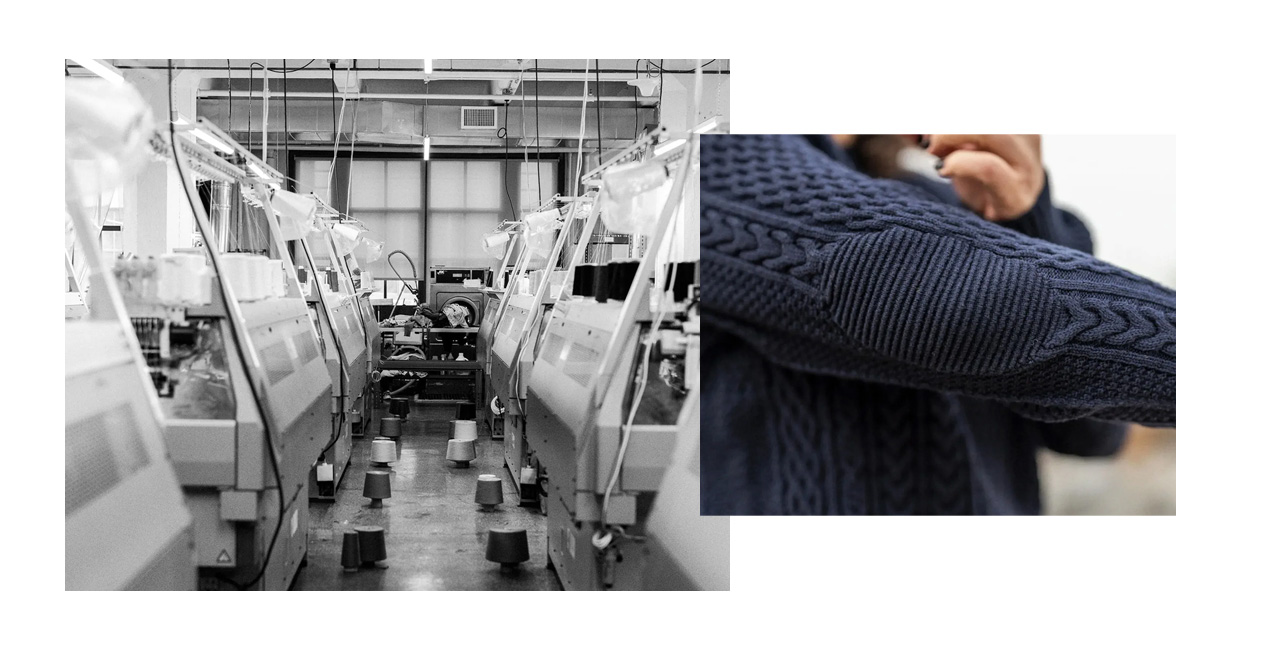
Unspun isn’t the only signal that something is shifting. Vermont-based merino wool brand Ibex is making their Nautilus Fisherman Sweater on a whole-garment knitting machine — the same Shima Seiki technology the industry largely ignored for thirty years, now producing a seamless knitwear piece made to order, with no panels, no seams, and no cut waste. Different product category, same underlying logic: build the garment in three dimensions from the start, make it when it’s sold, eliminate the waste the old process takes for granted.
The Question That Remains
Proof-of-concept is not the same as scale.
The Walmart pilot is exactly that — a pilot. Three hundred and fifty machines by 2030 is an ambition, not a guarantee. Ibex is making beautiful sweaters for a premium price point, which is not a mass-market proposition. And it’s worth remembering that Shima Seiki’s WHOLEGARMENT® machine was a proof-of-concept the industry admired and largely declined to adopt.
The question isn’t whether this technology works. It demonstrably does. The question is whether the economics can undercut the incumbent model at volume — without the green premium that Arens knows consumers won’t pay.
His bet is that they can. That Vega’s combination of speed, locality, and near-zero waste makes the numbers work without asking anyone to pay extra for their conscience. That the machine is the argument, not the marketing. And that hiring someone who has run some of the biggest brands in outdoor and action sports sends a signal the industry can’t easily ignore: this time, the people behind the technology understand the commercial reality they’re walking into.
If he’s right, the implications extend well beyond fashion. Every woven textile product — bags, packs, technical apparel, soft goods of every kind — is made by some version of the same process that Vega is replacing. Every one carries the same embedded waste. And if the technology continues to evolve, every one just might be a candidate for the same disruption.
Unspun’s Vega™ 3D woven collection is available at unspun.io.
Ibex’s Nautilus Fisherman Sweater is available at ibex.com.







Michael Knispel
Editor-In-Chief
Mike’s our editor-in-chief, storyteller, and master traveler. He’s been at the helm for over a decade, spearheading our stories, partnerships, and brand at large.



 WAYS TO CARRY