



 Carry Awards
 Insights
 Liking
 Projects
 Interviews
 Carry Candy
 Community and Marketplace

Which Bag Size Do I Need?
A lot of bags provide their volume size in liters. But how much will those bags actually fit? One 20L is not necessarily the same as another, with different shapes and opening styles affecting what you can pack. So if you’ve ever asked yourself “Which bag size do I need?” then check out the guide below for helpful insights and advice…
The first time I was about to buy a proper backpack I was overwhelmed by the question, which size do I need? And while all bags come with the standard volume measurement in liters, you still have no clue how much 20 liters actually fits.
Today I will try to answer the question which bag size do you need. Of course this is a difficult question to answer and many factors come into play such as flexibility of the material and loading style. I still wanted to illustrate with common items and common scenarios what you can fit into different volume sizes.
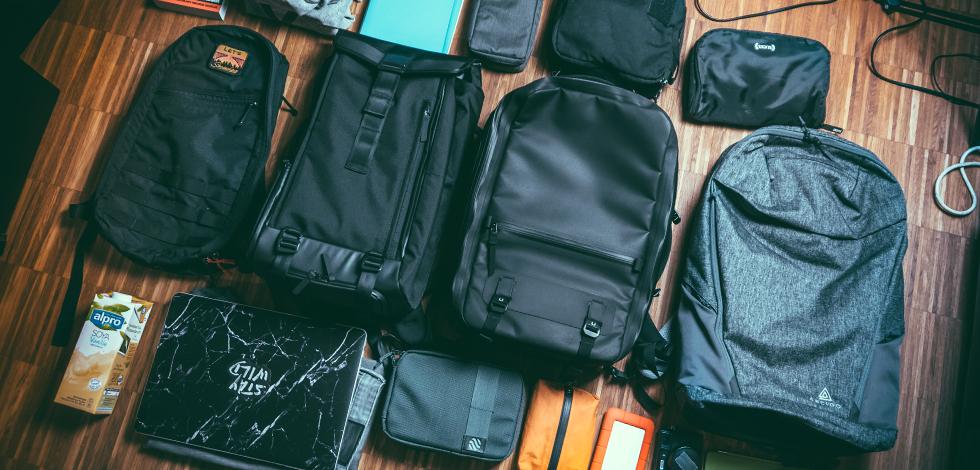
So the most common volume sizes are 10 liters represented with this GORUCK Bullet, 18 liters in this Farer Design Dayfarer, 25 litres in this Black Ember Citadel and 35 liters in this Arcido bag. To illustrate what you can fit into those different volumes I wanted to take a look at two scenarios: first the day-to-day I carry stuff to work kind of scenario and second, the travel-on-the-weekend scenario.
So for the first scenario I prepared these items to see which fit into all the specific volumes: 15-inch MacBook Pro, a mouse and the MacBook Pro charger both fitted into this pouch, a small hard drive, an old iPad, a Kindle, books with about 500 pages, a notebook, a camera, over-ear headphones, a pouch with my extended EDC with cables and small items, a packing cube with microphone equipment which is kind of representative for any other item like a lunch box for instance, and as a stand-in for a bottle a 1 litre milk carton. As bottles come in different sizes I assume that the milk carton is easier to evaluate. And last but not least just a sweater as a soft item.
For the second scenario which is the weekend trip, so from Friday to Sunday which means 2 nights I prepared these items: three shirts, three pairs of socks, three boxers, one or two sweaters, a pair of jeans and a medium-sized Dopp kit. I don’t include shoes in this scenario because shoes are a very specific factor. For instance, I have size US seven and a half which is rather small. For ease of use of this video I will pack most of this clothing in the packing cube.
We will start with the GORUCK 10-liter bullet. To keep a level playing field I chose only clamshell opening backpacks and I will only load the main compartment. It should be obvious that 10 liters is not a lot but 10 liters can fit surprisingly lots of stuff. But for this first scenario unfortunately you can’t fit a 15-inch laptop but most of the other items do fit, which is why to me personally 10 liters is basically just a great size for day-to-day trips around the city. If you don’t need a laptop for work or you have a smaller laptop or an iPad, then this could be great for work as well.
In the second scenario you can see that I can fit clothing but the Dopp kit is just too big, therefore this would be good for an overnight trip only.
The next bag is the Farer Design Dayfarer with 16 liters capacity; 16 to 20 liters is my favorite size for work or everyday carry. I can fit my laptop, my gear and whatever else I might need for work. Surprisingly everything fits perfectly into the 16 liters, therefore it shouldn’t be an issue to fit all the clothing in our second scenario.
The next bag is the Black Ember Citadel with 25 liters and this is the perfect example that many factors come into play when it comes down to capacity. As you can see, I had some trouble to perfectly load the bag. Although this bag is by numbers way bigger than the Dayfarer, I had trouble fitting everything into it easily. The Citadel has a rounded back panel for carrying comfort; this can actually get in the way of packing certain items such as boxy items like in this case, which means that you might not be able to use all the 25 litres.
But when you load soft items like in the second scenario, the rounded back panel of the bag does not get in the way and you can fit all of the clothing into the 25 liters.
The biggest bag of the four is the Arcido bag with 35 liters, which is considered to be a carry-on size. Although this would be too big for my height to use as an everyday carry bag, this would still be a good option as an everyday carry bag if you are taller. And with 35 liters it shouldn’t be surprising that everything fits into the bag and even for the second scenario the bag is big enough to even fit some more items into it.
Obviously this isn’t a scientific method and there are so many factors that come into play, for instance a top-loading backpack might not be as easy to load as a clamshell opening backpack or the material is stiff or flexible, which again changes how much you can load although the volume sizes might be the same. Or some outer compartments haven’t been accounted for in the overall volume size. Therefore, this shouldn’t be seen as an exact measurement but rather as an estimated point of reference to give you an idea of what size you might want to look at. So I hope this video helps you a little bit to answer the question of what volume size you might need for your next backpack.

 WAYS TO CARRY
Ok, so here’s the deal. Although this is a really well done video and an attempt to be helpful, it falls short.
I hate it when folks discuss or review bags and show how many articles of clothing that it will hold. The main reason for this is that people are different sizes! It’s not really difficult to fit a pair of pants, a couple of shirts, and a pair of shoes in ANY bag if you’re 5′ 3″, 130 lbs, and wear a size 8 shoe. I’m 6′ 2″ 230 lbs and wear a size 13. If you’re gonna use clothing for a reference, make sure that you at least mention the sizes as part of the review.
Also, there are no points of reference for this video, so I’ll provide some. When figuring comparative volumes, here’s a couple of common references:
1 gallon ziploc bag = 3.75 liters
“average” man’s shoe box = 11 liters
traditional Eastpak backpack = 24 liters
average disposable plastic grocery bag = 27 liters
carry-on size requirement (international) = 40 liters
Large Blue Ikea shopping bag = 71 Liters
Another frame of reference is that a men’s XL t-shirt fits snugly in a 1 Liter bottle.
Finally, always size your bag to have a little extra space in the main compartment beyond what you need to carry. This serves several functions:
1. It allows the bag to conform if you need to stuff it somewhere.
2. It provides room for unplanned extras that may be added during your day or trip.
3. It reduces stress on the zippers, buckles, and closures.
4. It can help to reduce or eliminate damage to things inside the bag because they have room to move away from the impact.
5. Most backpack and messenger-style bags carry best when slightly less than completely full. It gives the bag space to conform around your body and it helps to ensure that you’re not exceeding the weight capacity of the suspension or carry straps.
Wow, this might be the comment of the year, @vettepilot427:disqus! Lots of great feedback (and insights). So, our question to you, why aren’t you writing for us? 😉
If you guys are serious, I would love to try. I have experience, insight, and background that I think could be of use and interest to the community. I’ve followed Carryology for a few years now and have always been impressed with the breadth and depth of the content. Whom do I contact for more information?
Right on, @vettepilot427:disqus! Drop Mike a line on info@carryology.com.
Totally agree. Also, backpacks fit way differently on different body types. Many popular models are so small on 6’4/220lbs. On the other hand bigger models are too huge, and out-of place. I’d like to see some wide(side to size), not so deep, but tall model. That way I will be able to fit more stuff, but it won’t look too bulky.
For me, max size is 37L (F-stop Loka), smallest size is 24 liters – zero sense to have anything smaller, honestly. Ideal size is closer to 30 liters, but depends on the shape (see above) might be a bit more.